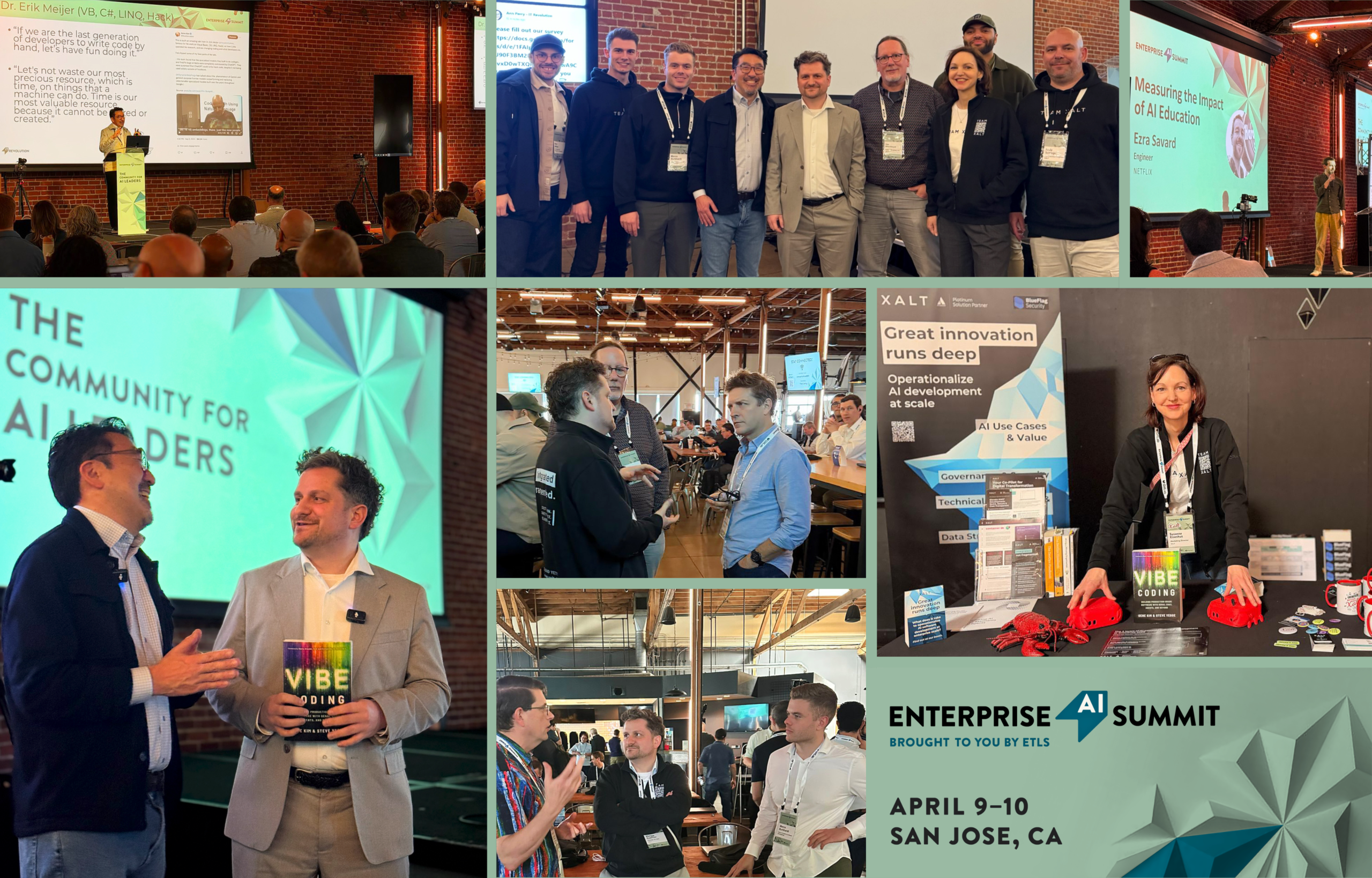
The Enterprise AI Summit 2026 in San Jose has highlighted a technological shift that is fundamentally changing software development. What was considered a vision just a few years ago is now a reality: AI agents are managing entire workflows, and companies face the challenge of leveraging this speed safely and profitably. For C-level executives and IT leaders, the message is clear: AI is no longer a luxury, but a necessity for survival.
For us at XALT, the Summit perfectly validated our strategic roadmap. While Silicon Valley delivers visionary speed, German and European companies require robust implementation, compliance, and integration to scale these capabilities securely. In this article, you will learn which trends shaped the summit, which mistakes companies should avoid, and how XALT supports you in scaling AI securely and efficiently.
The most common road blocks in AI projects today
Many companies underestimate the speed and scale at which AI is transforming software development. While orchestrated AI fleets ("Fleet Mode") are already autonomously managing entire processes in Silicon Valley, many organizations are still struggling with individual initiatives and isolated chatbots. Typical mistakes:
- Focus on code instead of infrastructure (harness)
- Overloaded, outdated CI/CD pipelines that can no longer keep up with AI-generated code
- Lack of compliance and security mechanisms for autonomous agents
- Exploding costs due to inefficient token usage
- The "autonomy trap": AI agents make micro-decisions without human control - with suboptimal results
Surveys and field reports from the last two years show: Those who view AI merely as a tool will fall behind. The implementation of AI has become a matter of survival.
The Summit demonstrated: The future belongs to orchestrated AI agents that handle not just individual tasks, but entire workflows. Competitive advantage is no longer found in the code itself, but in the ability to provide a secure, context-rich, and compliance-ready infrastructure ("Harness"). Companies must design their processes, data models, and governance structures so that AI agents can operate safely and efficiently.
The top insights for IT leaders and teams to successfully introduce AI
The Enterprise AI Summit 2026 (an IT Revolution event) impressively demonstrated how rapidly the AI landscape is changing and what challenges and opportunities this presents for companies. Here are the key findings:
1. Infrastructure beats code
The time when the best code made the difference is over. AI agents generate in minutes what used to take weeks. The real competitive advantage now lies in a secure, scalable infrastructure that seamlessly connects data models, integrations, telemetry and compliance. This is the only way to deploy AI agents securely and efficiently.
XALT recommendation:
- Instead of relying on individual AI tools, you should create a robust infrastructure
- Embed developer documentation
- Implement clear rules and policy-as-code
- Shift compliance "to the left" (Shift Left)
- Establish immutable audit trails and formal verification checks
2. Traditional development processes reach their limits
Traditional CI/CD pipelines and review processes are overwhelmed by the speed and volume of AI-generated code. Companies need to radically automate their development and deployment processes and rely on continuous deployment and production-like test environments.
XALT recommendation:
- Rely on highly automated CI/CD pipelines that are specifically designed for AI-generated code
- Integrate production-related, automated test environments to ensure quality and safety even at high throughput rates
- Implement Continuous Deployment so that new AI functions reach production quickly, securely and traceably
- Continuously monitor and optimize your processes to identify and eliminate bottlenecks at an early stage
3. Security and compliance are mandatory
AI agents must be considered potentially unsafe until their safety is proven. Formal checks, audit trails and policy-as-code are becoming the standard to minimize risks and meet regulatory requirements.
XALT recommendation:
- Initially treat all AI agents and their actions as unsafe ("guilty until proven safe")
- Implement formal checks and mathematical verifications before AI agents are used productively
- Build immutable audit trails and automated compliance controls into your platform
- Use policy-as-code to enforce security and compliance rules in a transparent, traceable and automated manner
4. Token efficiency becomes a cost factor
Although the cost per AI token has fallen massively, overall expenditure is increasing due to greater usage and context windows. Companies must design their AI workloads efficiently to avoid cost explosions.
XALT recommendation:
- Analyze AI workloads with Big-T notation to identify where unnecessary tokens are being consumed. It ensures that simple tasks such as data queries or filtering do not have to be performed by the AI every time. This means you only use the AI for really complex tasks and save resources in the process.
- Token consumption can be drastically reduced through caching, preprocessing and intelligent routing.
- This reduces token consumption by up to 90% without any loss of performance.
5. Humans and AI as a team
The best results are achieved when AI agents and humans work closely together. Companies that rely purely on autonomy run the risk of achieving suboptimal results. Successful teams use AI as a force multiplier and rely on gradual modernization instead of big bang.
XALT recommendation:
- Focus on gradual modernization instead of automating everything at once
- Use legacy code as a test environment for AI agents
- Feed agents with rich context from shared repositories
- Enable teams and leaders with Vibe Coding Workshops to use AI more efficiently and safely
Real-world AI: business outcomes of leading companies
The Enterprise AI Summit 2026 also showed that AI is no longer just a field of experimentation, but is already delivering measurable business results in many companies. The following examples illustrate how well-known organizations are successfully using AI and the concrete business outcomes they are achieving.
Cisco
The technology company implemented a clear management directive: Each team leader had to develop an AI agent feature within three months. The result: 85% of senior directors showed a measurable change in behavior towards more empowerment and innovation. Automated knowledge management systems and predictive dashboards sustainably increased the quality of teamwork.
John Deere
The agricultural machinery manufacturer launched a company-wide AI transformation without a fixed timetable. The goal was 90% weekly and 70% almost daily AI usage. Graduated training programs and peer-to-peer advocacy massively increased adoption and productivity. Today, 90% of code is written with AI support.
LaunchDarkly
The software company modernized 66,000 lines of legacy code with AI in less than two weeks. The experience showed that human control remains crucial for the effectiveness of AI agents. Bottlenecks shift from development to the review and validation processes - the autonomy trap was recognized and addressed.
Skypoint Health
The AI-native healthcare company replaced 100 legacy SaaS systems and now serves over 1,100 healthcare sites. Developer performance increased 5 to 12 times, research & development costs decreased by 50%. The key success factor: compliance was built into the platform from the start, not as an afterthought. HIPAA and regulatory requirements (FedRAMP-R2) are not seen as a brake at Skypoint, but as a competitive advantage. This principle of „Shift Compliance Left“ is one of the strongest differentiators in the regulated healthcare market today.
Disney
The entertainment group developed the AI agent "Sam" with short and long-term memory for coding, research and presentations. The aim is to create tenfold added value for employees and guests. AI is seen as a natural evolution of IT and strengthens the brand through better, safer and more personalized experiences.
Vanguard
The financial company relies on automated prompt optimization using evolutionary algorithms. Result: 99% target fulfillment at moderate token costs. AI-supported systems run around the clock and replace months of manual reconciliation processes.
Conclusion and recommendation to our customers
The Enterprise AI Summit 2026 impressively demonstrated that AI is not just a technology topic, but a strategic success factor for companies. The practical examples prove it: Those who use AI in a targeted manner can radically speed up processes, reduce costs and tap into completely new value creation potential.
Use the Summit's findings as an impetus to critically scrutinize and further develop your own AI strategy.
- Check whether your infrastructure, governance and development processes are already designed for AI scaling.
- Focus on continuous training and empower your teams to use AI actively and responsibly.
- Start with pilot projects that deliver real added value and gradually scale successful approaches within the company.
- Don't think of AI as a stand-alone tool, but as an integral part of your value chain.
This will ensure that your company not only benefits from current AI trends, but also remains competitive in the long term.
Want to know how fit your company is for the AI era?
Arrange your individual AI assessment with XALT now and find out how you can put the vision from San Jose into practice safely and compliantly.