
Author: Richard Richter
DevOps Engineer at XALT
Artificial intelligence, especially generative AI, has long become a critical business tool. Companies are racing to integrate AI to boost productivity, secure a competitive advantage, and reach new levels of cost efficiency. But this rapid adoption has a dark side: AI security. Every employee who uses an AI tool to summarize notes or write code creates a new, often invisible data flow. This use of “shadow AI,” combined with officially approved tools, opens Pandora’s box to significant security risks—from massive data leaks to corrupted decision-making processes.
The core problem isn’t AI itself; it’s the failure to secure it. This article provides IT managers and business decision-makers with a clear, actionable framework for AI security. We move away from theory toward a practical plan for risk reduction, enabling companies to harness the power of AI safely and confidently.
The new risk frontier: The most significant threats to AI security explained
Before you can build a defense, you need to understand the threat. Unlike traditional security, which focuses on perimeter protection, AI security must also defend the logic and the data of the models themselves.
Data leaks & privacy violations
This is the most immediate and common risk. Employees who want to be productive may copy sensitive data (e.g., customer lists, proprietary code, personal employee data) into public AI prompts. This information can flow into the model’s training data and potentially resurface in another user’s query (even outside the company). This is a direct path to a compliance nightmare (GDPR) and the loss of intellectual property.

Model poisoning & attacks on AI logic
Alongside unintentional data leaks, data poisoning is also becoming increasingly important. IBM describes data poisoning as a form of cyberattack in which threat actors deliberately manipulate or corrupt the training data of AI and ML models in order to influence the models’ behavior.
Imagine an attacker subtly feeding false data into a financial model, resulting in disastrous trading recommendations. Attacks such as „prompt injection“ work in a similar way, where a hidden command in a document forces the AI to ignore its security protocols and perform malicious actions, such as exfiltrating user data.
„Shadow AI“ & untested tools
Your teams are probably already using AI, whether you have a policy for it or not. According to surveys, only about one in three companies still assumes this isn’t happening. When employees sign up for free, unvetted AI tools using their work accounts, they may be granting those tools broad access to company data (such as emails or cloud drives) without any security oversight. This creates a massive, undocumented attack surface.
A three-pillar framework for minimizing risk in AI
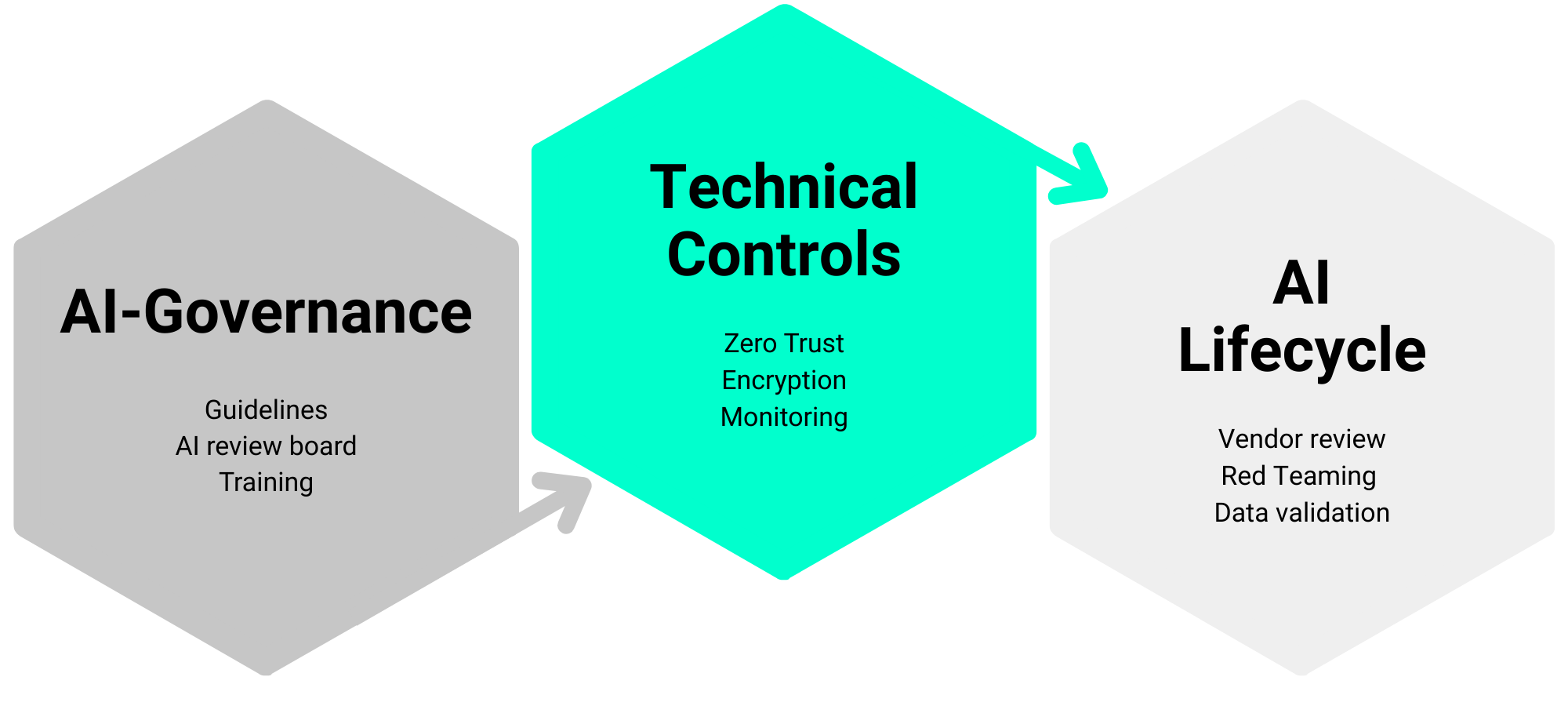
A secure AI strategy does not consist of a single tool; it is a comprehensive approach based on three pillars.
1. Establish robust AI governance
(The „why“ and „who“)
- Create a clear policy: Define what is acceptable and what isn’t. Which tools are approved? Which data types (e.g., “Public,” “Internal,” “Confidential”) may be used with which tools?
- Establish an AI review board: Assemble a cross-functional team (IT, Legal, Operations) to review and approve new AI tools and use cases.
- Train your employees: Your team is your first line of defense. Teach them to recognize risks, understand data classification policies, and identify AI-driven phishing or deepfakes.
- Use proven frameworks: Don’t reinvent the wheel. Base your governance on industry standards such as the NIST AI Risk Management Framework (RMF).
2. Implement strong technical controls
(The „how“)
- Enforce access control: Implement a zero trust model and the principle of least privilege. AI agents and users should have access to only the absolute minimum data required to perform their task.
- Secure your data: Encrypt all sensitive data, both at rest and in transit. Use data anonymization and masking techniques before any data is ever sent to an AI model for analysis.
- Monitoring & Audits: You can't secure what you can't see. Implement continuous monitoring to log all AI queries, detect anomalies (e.g., a user suddenly downloading huge data sets), and secure the APIs that connect AI to your core systems.
3. Securing the AI lifecycle
(The „what“)
- Vet your vendors: If you use third-party AI, require access to their security and compliance documentation (e.g., SOC 2 report, data processing policies).
- Test the models (or their models): For critical internal or vendor models, conduct adversarial testing (red teaming). Actively try to trick, poison, or break the model to find vulnerabilities before an attacker does.
- Validate your data: For internal models, ensure that your training data is clean, validated, and free of bias or manipulation. Your AI’s output is only as good as its input.
AI security is not a cost factor, but a trailblazer
Many executives view security as a cost center. That is a critical mistake. In the age of AI, strong AI security is the only thing that truly protects your ROI. Because:
AI initiatives are designed to create a competitive advantage and drive cost efficiency. A single data breach or a poisoned AI model doesn’t just halt that progress—it reverses it and buries your team under regulatory fines, reputational damage, and the catastrophic loss of customer trust.
At XALT, we see risk reduction as a catalyst for innovation. By building a secure foundation, you enable your teams to experiment, automate, and innovate safely. They move faster than competitors who are either paralyzed by risk or recklessly exposed. Secure AI doesn’t mean slowing down; it means building the high-speed road that ensures your company’s most valuable assets reach their destination intact.
Conclusion: Key findings
- AI is a business necessity: Ignoring AI is no longer an option, as it is a key driver of efficiency and competitive advantage.
- The risk is real and new: The main risks—data leaks, model poisoning, and shadow AI—target the core logic and data of AI systems and can have devastating consequences.
- Security enables innovation: A proactive AI security strategy built on the pillars of governance, technical controls, and lifecycle security is not an obstacle. It is the essential foundation that protects your ROI and enables you to innovate with speed and confidence.
The path to optimization with XALT
This framework may seem complex, but you don’t have to implement it alone. XALT specializes in supporting companies at the intersection of process optimization, Atlassian tools, and advanced automation. We help you create governance policies, technical guardrails, and automated workflows to secure your AI adoption from day one.
Are you ready to transform your workflows and harness the power of AI securely? Contact the experts at XALT for a consultation.