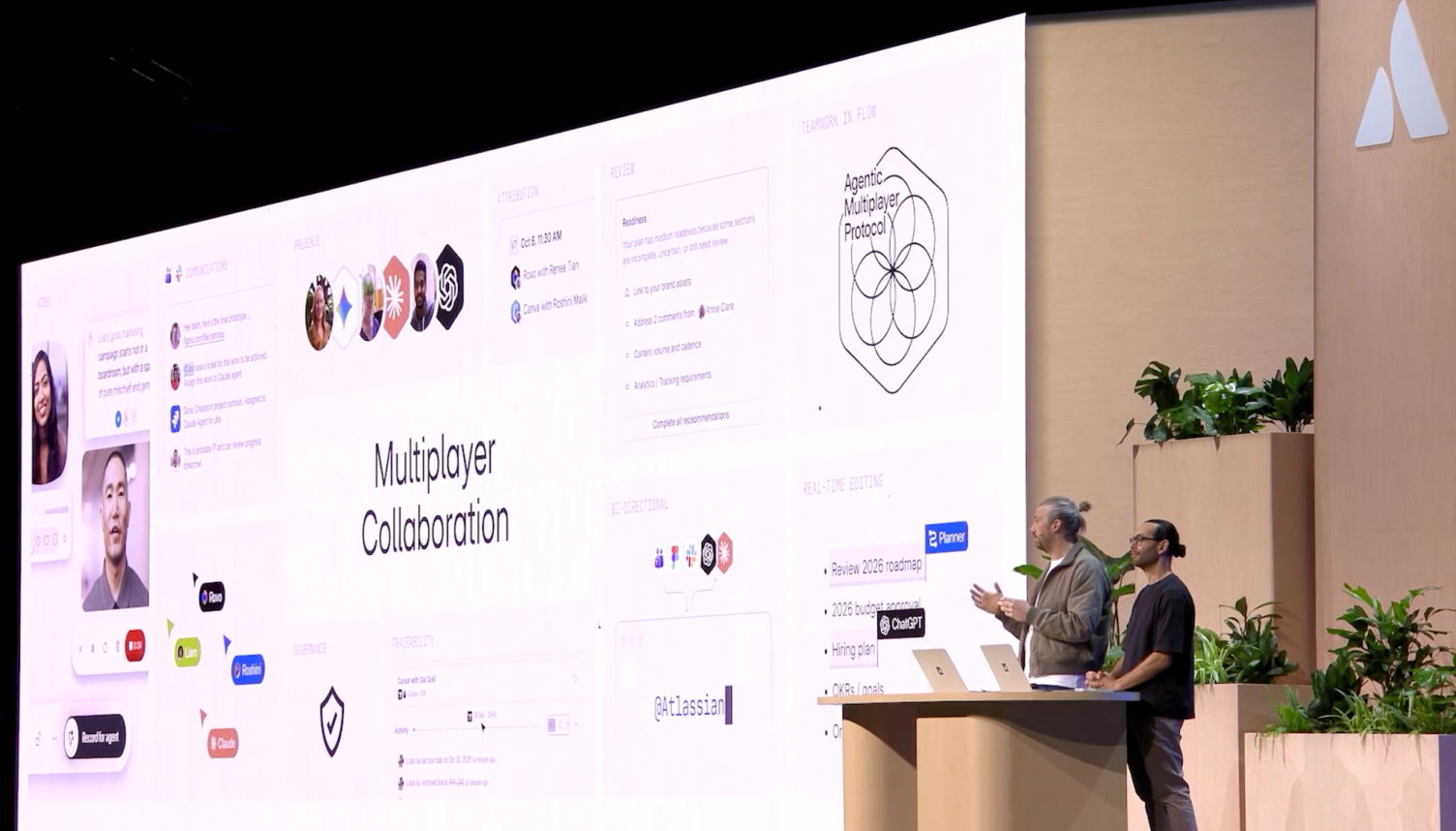
Atlassian Team ’26 in Amsterdam made one thing clear: the era of isolated AI tools is over. AI is evolving from a tool into an autonomous member of the team. TEAM XALT was there to witness the launch of the Agentic Multiplayer Protocol (AMP) and the major expansion of the Teamwork Graph.
Here Are the Key Announcements at a Glance:
- AMP Makes AI Agents Accountable Team Members: Agents are assigned identities, roles and permissions, while their actions remain visible and traceable through Jira work items.
- Rovo Work, Rovo Desktop and Artifacts expand AI support: Rovo takes on multi-step tasks, brings context closer to the workplace and stores AI results as persistent, shareable artifacts.
- Teamwork Graph and the new Atlassian MCP Server provide more context: Code structures, data warehouse data and around 220 tools connect Atlassian more closely with external AI clients and automations.
- EU AI Inference and Atlassian Guard Strengthen Security and Compliance: AI requests can be processed within the EU, with sensitive data better protected during AI interactions.
Multiplayer Collaboration Redefined
In Amsterdam, Atlassian showed that multiplayer collaboration only works when everyone plays by the same rules, whether they are human or an agent. Technical integration alone is not enough; a shared understanding of roles, context and responsibility is equally important. The following points outline the principles and features shaping this new form of collaboration.
Agentic Multiplayer Protocol: Identity and Trust for Agents
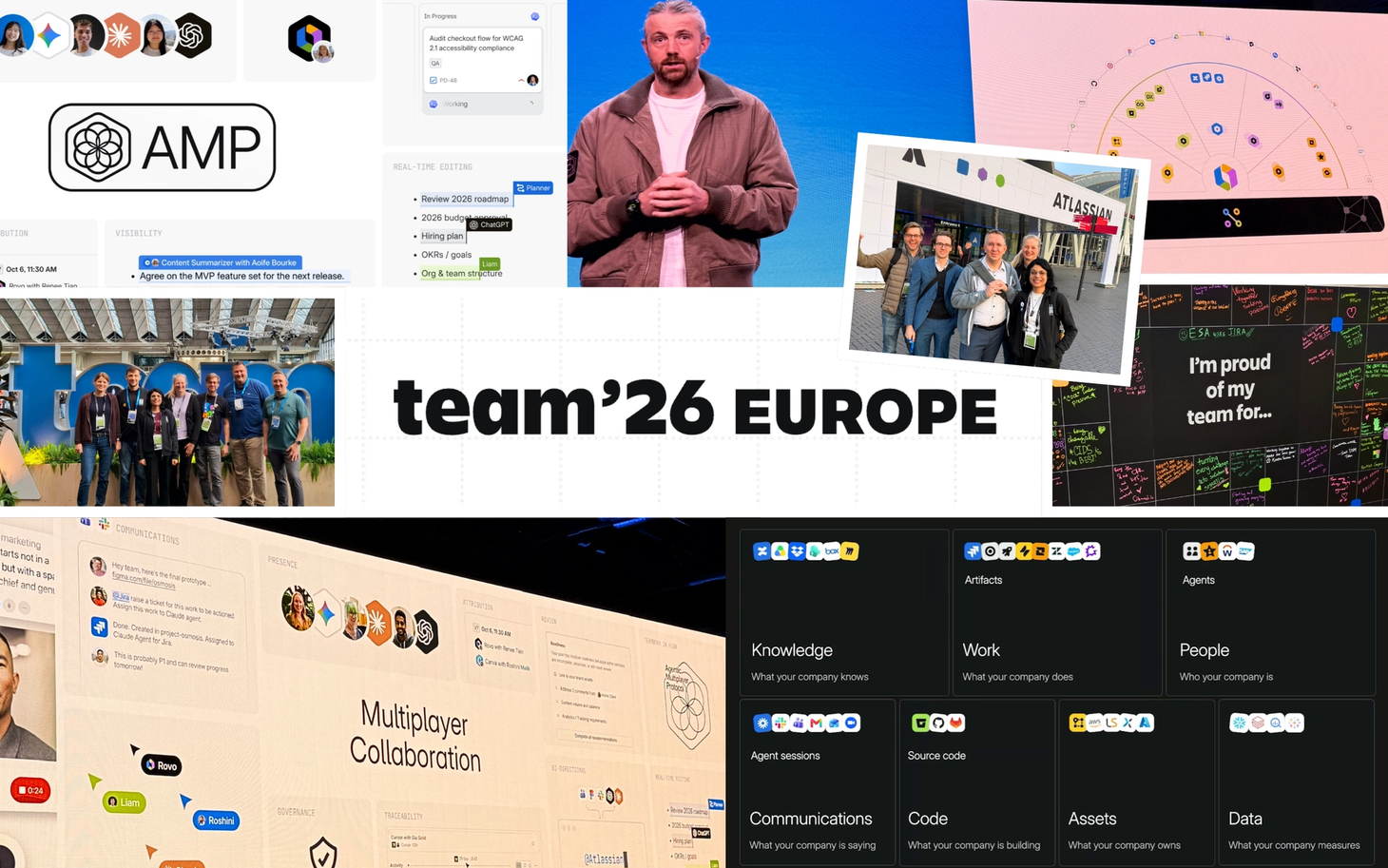
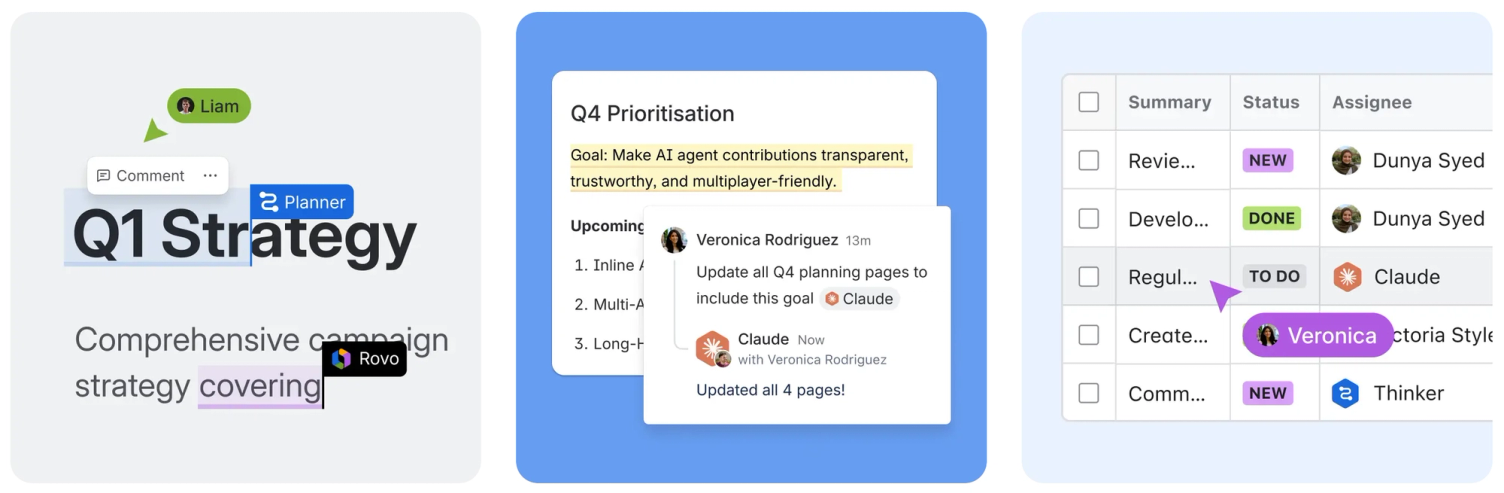
The Agentic Multiplayer Protocol (AMP) gives each agent its own identity and a clearly defined area of expertise. Agents are now visible participants in the workflow, with their actions linked to Jira work items and fully traceable.
You no longer have to wonder who did what. Agents operate within the guardrails set by admins, and their work is transparent to the entire team.
Alongside the governance benefits, this is a crucial step towards involving agents in tasks just like human team members. Collaborate live with your agent in a document, tag it in comments and assign Jira work items to it, just as you would with a colleague.
Availability: Integrated into the Atlassian platform and available now.
Rovo Work & Desktop: From Chatbot to Autonomous Team Member
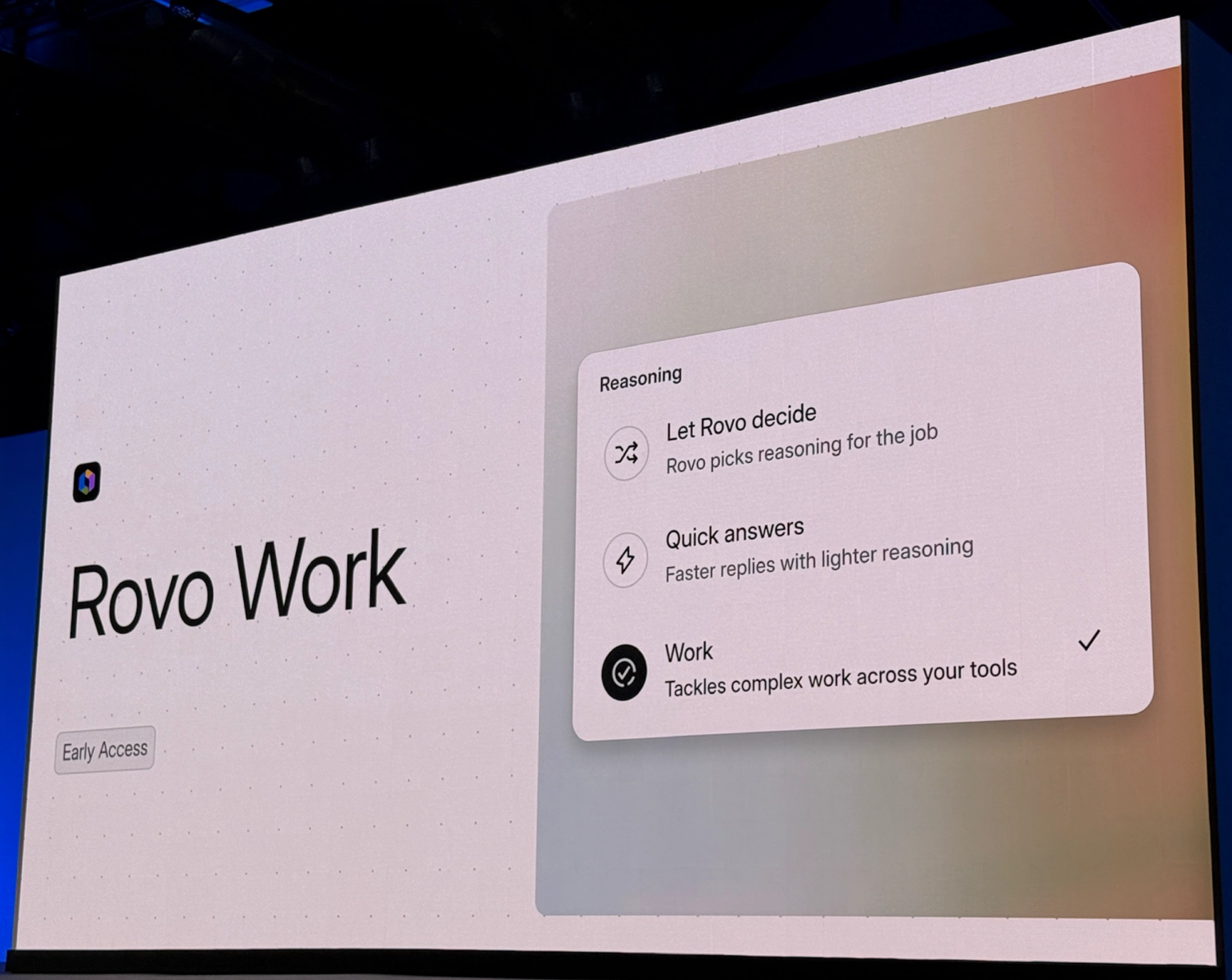
With Rovo Work, AI can handle more than individual prompts. It can also take on complex, multi-stage tasks spanning several steps, from planning and research to actions in Jira and scripting in a secure sandbox.
In addition, Rovo Desktop brings Rovo directly to the desktop, allowing teams to use it beyond individual Atlassian products and access context from pages, tickets, chats and other connected tools more quickly. Short video or audio briefings from Loom (Record for Agent) will also be able to serve as a starting point for agent work, while automatically generated visual overlays will make Loom videos (AI Overlays) clearer and more professional. For customers, this means less context switching, a faster path from question to action and AI support that is more closely aligned with how they actually work.
This enables teams to launch time-consuming workflows faster, track each stage more transparently and use the results directly where the work already happens.
Availability:
- Rovo Work: Early access for selected customers or via sign-up.
- Rovo Desktop: Beta – publicly available for testing, not yet final.
- Loom Record for Agent: Open Beta.
- Loom AI Overlays: Coming Soon.
Artifacts App: Save AI Outputs Permanently and Share Them With Your Team
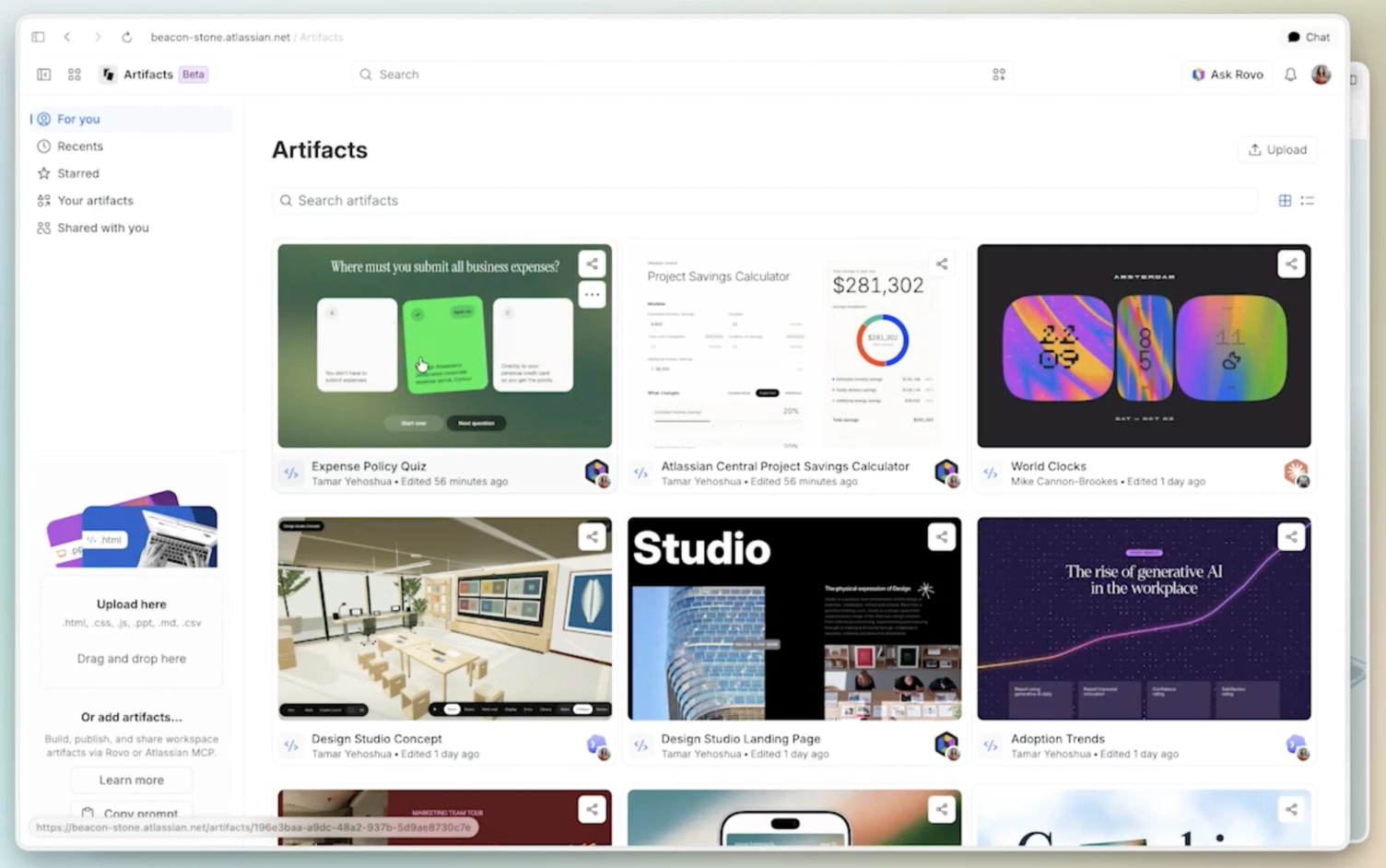
The new Artifacts App ensures that AI-generated results do not disappear into your chat history. Plans, analyses, models and other outputs are saved as permanent artefacts, given permanent URLs and can be embedded in Confluence, Jira or external tools.
This turns fleeting AI responses into shareable, reusable and documentable assets that provide a reliable basis for decisions, collaboration and follow-up work.
Availability: Open beta – publicly available for testing, not yet final.
Enhanced Teamwork Graph: More Context for People and AI
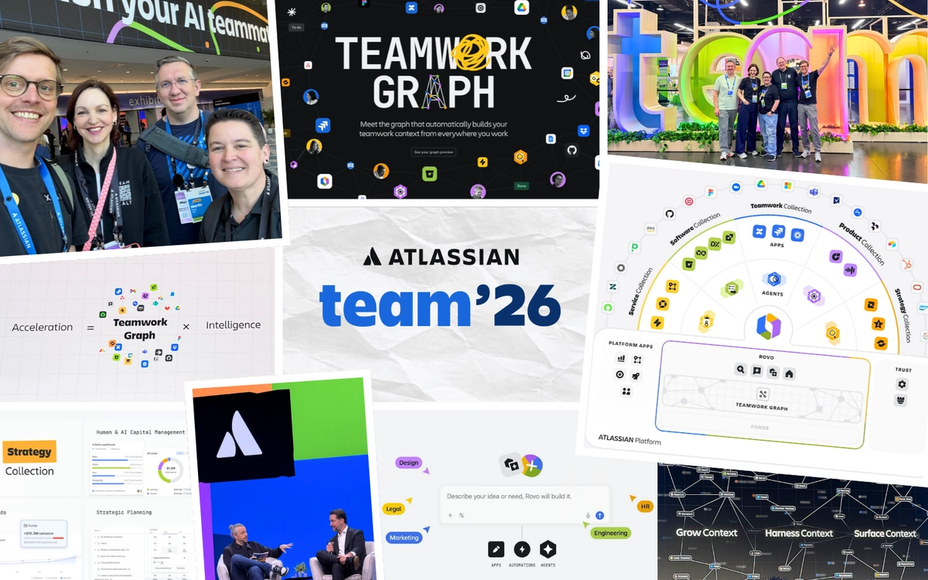
With the expanded Teamwork Graph, Atlassian is significantly extending the shared knowledge base for human-AI collaboration. Atlassian has announced that the graph will now connect code structures and structured information from data warehouses alongside traditional work data from Jira, Confluence and other tools. With more than 250 billion connections, this creates a far more precise context model, helping Rovo and other agents understand relationships more effectively, provide more relevant answers and align actions more closely with how teams actually work.
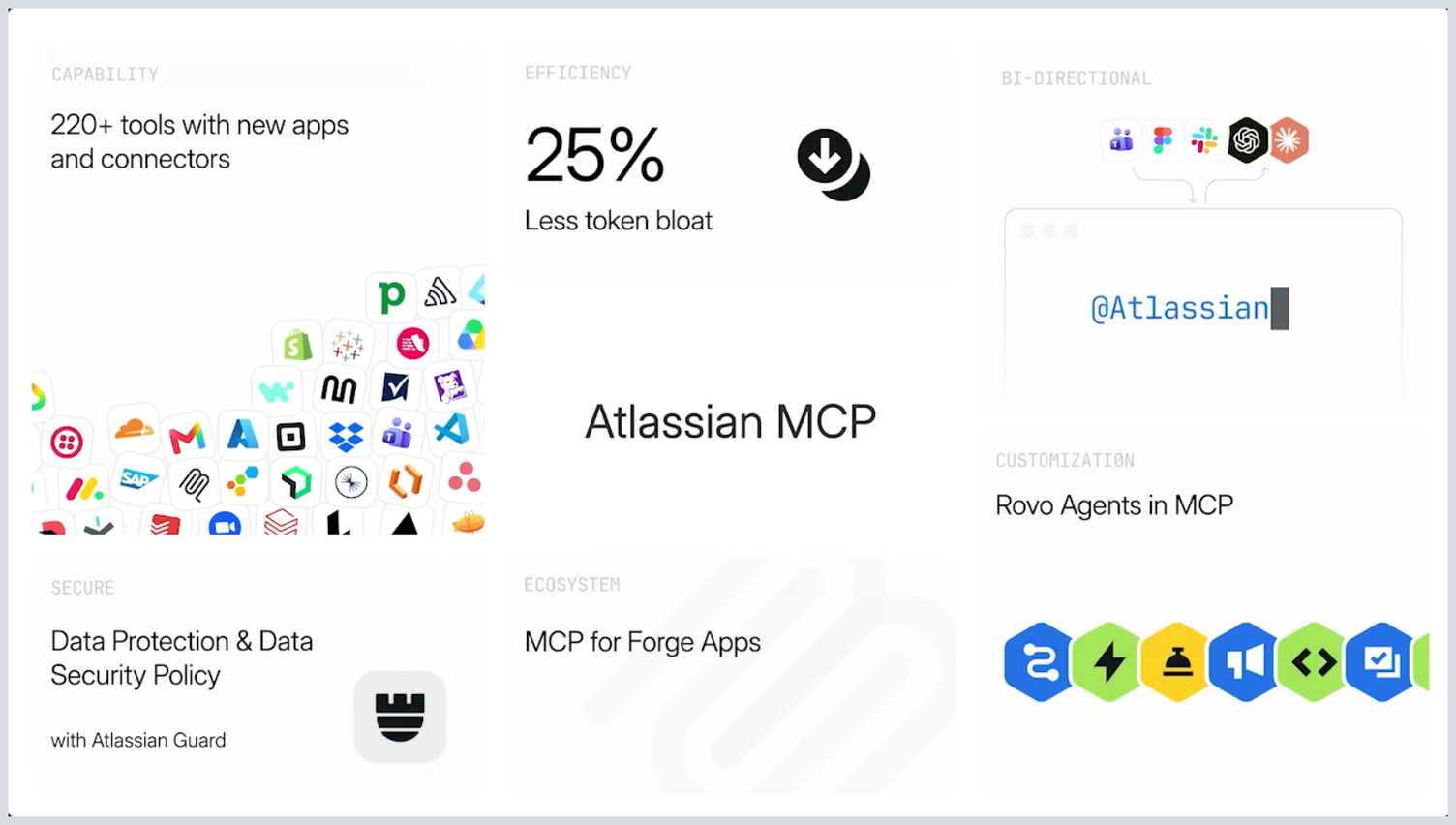
This is complemented by the newly developed Atlassian MCP Server. Around 220 tools are now available, enabling agents to work across almost all Atlassian apps and Collections. At the same time, the MCP Server draws on significantly more context from the Teamwork Graph and, in future, will also be able to incorporate custom Forge apps, Marketplace apps and your own Rovo agents.
For customers, the MCP Server provides a secure interface between external AI clients such as ChatGPT, Claude, IDEs or automation tools and Atlassian Cloud. Crucially, governance is managed through Atlassian Guard, existing permissions remain in place, and access can be controlled and audited. At the same time, the new MCP Server is expected to use up to 25% fewer tokens than traditional SaaS integrations. This reduces friction, costs and context loss, making it easier to turn ideas from an AI tool directly into specific Jira work, Confluence content or development tasks.
EU AI Inference & Atlassian Guard
For companies in the DACH market in particular, where and how AI processes data matters. With Local EU AI Inference, Atlassian processes sensitive AI requests exclusively through models hosted in the EU (this is not enabled by default; it is available in Early Access and requires registration). Atlassian Guard Premium complements this by detecting and protecting sensitive data in AI interactions in real time.
Rovo is certified to ISO 42001 and aligned with the EU AI Act, making it easier for customers to carry out their own compliance checks
Availability: Early Access Program, registration required.
More New Features From Team ’26 Europe
Alongside the major themes of AMP, Rovo and Teamwork Graph, Team ’26 Europe featured several specific product announcements that will have a direct impact on teams’ day-to-day work:
- Teamwork Collection: Teamwork Collection brings together tools for collaboration, knowledge and communication. Atlassian is developing Jira, Confluence, Loom and Rovo into a more integrated workspace where teams and AI agents work with the same context, making decisions easier to understand and outcomes easier to reuse.
- Software Collection: The Software Collection shows how Atlassian aims to make the entire development process more AI-native — from planning and specification to code context, review and delivery. The focus is less on any single feature and more on a connected software lifecycle in which agents provide targeted support to development teams while keeping work traceable.
- Service Collection: The Service Collection shifts the focus from reactive ticket handling to proactive, AI-powered service management. Atlassian aims to help teams set up services faster, identify risks earlier, coordinate incidents more effectively and make better use of knowledge throughout the service process.
- Strategy Collection: The Strategy Collection brings strategy, investment, capacity and delivery into closer alignment. It helps leadership teams see whether priorities, budgets, teams and outcomes are aligned – and how AI initiatives deliver real impact.
In further blog posts, we will take a closer look at the specific updates within each Collection, exploring their benefits, availability and potential use cases.
Conclusion and Recommendations for Our Customers
Atlassian's announcements show that the real ROI of AI comes from combining context, trust and robust governance rather than from individual tools. For XALT customers, this means laying the foundations now so that human-AI collaboration can scale securely, transparently and effectively.
- Strengthen Context and Data Foundations: Connect relevant knowledge sources, code and structured business data to Atlassian. At the same time, clean up outdated Confluence content and review permissions so that AI agents can work with reliable context.
- Establish Agent Governance: Use AMP and Atlassian Guard to manage AI agents like digital team members, with clear roles, traceable actions, controlled permissions and compliance guardrails for the European market.
- Take a Pragmatic Approach with Available Features: Do not make tools that are not yet generally available a mandatory step. Instead, start with specific pilot use cases in existing Atlassian workflows, assess EU AI inference and guard requirements early, and prepare teams for transparent human-AI collaboration.
Are you ready for the multiplayer team of the future? Let's explore how you can safely introduce Rovo and agents using AMP principles.