If you are testing AI agents in your organisation, the pattern may sound familiar: the pilot impresses, the team sees early success, and complexity grows as soon as multiple departments, data sources and compliance requirements enter the picture. This is where scaling agentic AI across an enterprise can break down. According to Gartner, in 2026 only 22 per cent of surveyed organisations had successfully scaled AI across multiple business units or established an AI-first approach.
The difficulty rarely lies in the absence of a model. Fragmented context, unclear permissions, limited traceability and governance introduced only after the pilot all play a part. Atlassian’s Agentic Multiplayer Protocol (AMP) addresses these issues.
Here we explore how these elements can form a reliable operating model for people and AI agents.
Why Enterprise AI Stalls at Scale
A single assistant in a small team is relatively easy to control. Enterprise environments bring together multiple tools, identities, data classifications, business units and regulatory requirements. Common obstacles include:
- Context remains trapped in individual tools. A coding agent knows the repository change, a Jira agent knows the ticket, and Confluence holds the architectural decision. Without connections, each agent works from only part of the picture.
- Permissions are difficult to trace. Teams may not know whether an agent acts with the invoking user’s rights, a service account or its own identity.
- Actions disappear into black boxes. When results are copied from isolated chats, the history, source and reasoning can be lost, making reviews and audits harder.
- Human and AI actions are not clearly separated. Legal and regulatory requirements increasingly call for a clear distinction between human and AI actions. In enterprise settings this typically concerns transparency, labelling and documentation duties, such as those under the EU AI Act and internal compliance policies. Without that distinction, it can be difficult to demonstrate accountability during an audit.
- Shadow AI grows faster than governance. Business teams create productive shortcuts while IT, privacy and security lack a complete view of data flows and external tools.
- Pilot processes are replicated without review. A use case is extended to other teams before data quality, roles and escalation paths have been settled.
- Activity is mistaken for impact. Prompt or agent counts reveal little about turnaround time, quality, risk or actual business value.
The result: organisations either slow down over risk concerns or scale without control, creating new technical and organisational debt.
What Does Enterprise AI Need to Scale?
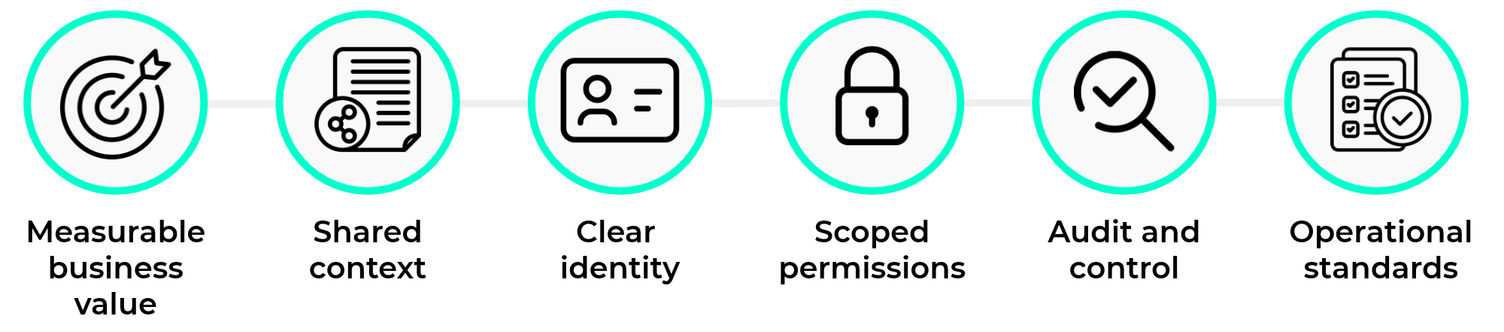
Scalable enterprise AI brings together six foundations: a clear business purpose, shared and current context, distinct identities, limited permissions, audit and human oversight, and operating standards. Together they form an operating model for people, agents and the systems both use.
1. Business Purpose and Measurable Value
Every agent needs a clearly bounded task. A useful use case specifies inputs, desired outcomes, owners and success criteria, making it easier to see whether the agent improves a real process or merely adds activity.
2. Shared, Current Context
Agents need access to information relevant to their task, including documents, tickets, decisions, code, assets and responsibilities. That context needs traceable sources, current content and understandable relationships between objects.
3. Distinct Identity
Every agent should be recognisable as an actor. A dedicated identity makes it easier to assign rights, analyse logs and stop individual agents. When an agent acts on a user’s behalf, that mode must also be clear.
4. Limited Permissions
Reading, drafting, changing internal data and triggering external communications represent different risk levels. Permissions should reflect those levels. Critical actions need targeted approvals, while lower-risk tasks may allow greater automation.
5. Audit and Human Oversight
Teams need to see what an agent did and the basis for its actions. Every critical workflow also needs defined review, escalation and stop points. People remain involved where impact, uncertainty or regulation requires it.
6. Operating Standards
Each new agent adds testing, versioning, monitoring and cost-control work. Reusable standards help prevent every team from developing its own operating logic.
Atlassian’s Agentic Multiplayer Protocol as an Enterprise Operating Model
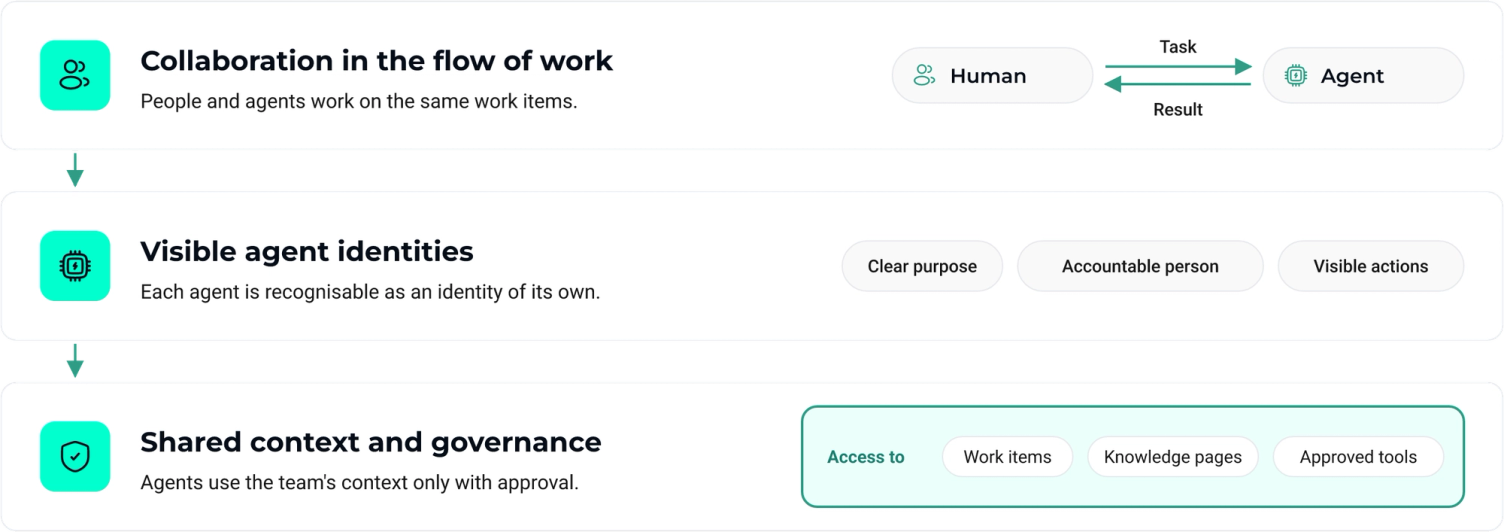
Atlassian addresses these challenges with the Agentic Multiplayer Protocol (AMP), a framework for collaboration between people and AI agents within and beyond its platform. It combines collaboration in the flow of work, visible agent identities and shared context with governance. People remain responsible for significant decisions; agents assist and act within defined boundaries.
AMP can be understood as an operating model that brings together several platform components and responsibilities:
- Collaboration in the flow of work: Agents are integrated into Jira, Confluence, Loom, automations or through MCP.
- Identity and attribution: Actions should be attributable to a specific agent or the invoking user.
- Shared context: The Teamwork Graph connects work, knowledge, people, communications, code, assets and data.
- Permissions: Existing access rules and policies limit the content and tools an agent may use.
- Traceability: Activities are documented so teams can review results and establish responsibility.
- Open ecosystem: External agents and AI clients can also work with authorised context through Atlassian MCP.
Atlassian’s official AMP description calls this “multiplayer human-agent work”: people and agents working with shared context under shared rules.
How AMP Supports Governance and Compliance
AMP expressly targets regulatory requirements that call for a clear distinction and separation between human actions and AI actions (“supports regulatory requirements to separate AI vs human actions”).
Compliance for agentic AI requires more than approval before go-live. An agent can read data, create content, invoke tools and trigger work. Organisations therefore need to control and trace each of these capabilities.
AMP provides a useful framework:
- Identity: Who or what acted? AMP treats agents as distinct non-human identities, with user-like accounts, groups and product access rights. This establishes who or what is acting and maintains accountability.
- Permission: Which data and actions were authorised?
- Context: What information informed the decision?
- Traceability: Which steps and results are documented? Linking actions to an identity and logging agent actions makes outputs and tool calls traceable (“increases traceability and responsibility for outputs”).
- Control: Where are human review, approval or escalation needed?
This governance and identity framework makes AI agents ready for use in regulated enterprises. Its technical foundations include Atlassian Guard, data classification, Data Security Policies, administrative controls and audit logs. The Atlassian MCP Server connects external AI clients to Atlassian tools under central governance controls.
For planning, availability varies. According to Atlassian, EU AI Inference is currently in Early Access and requires registration. Some features involving Agent Accounts (the user-like accounts mentioned above) and central inventory are rolling out gradually or have been announced. Check the current status for your plan and instance before making architecture decisions; an announcement does not establish production availability.
Governance Is a Shared Responsibility
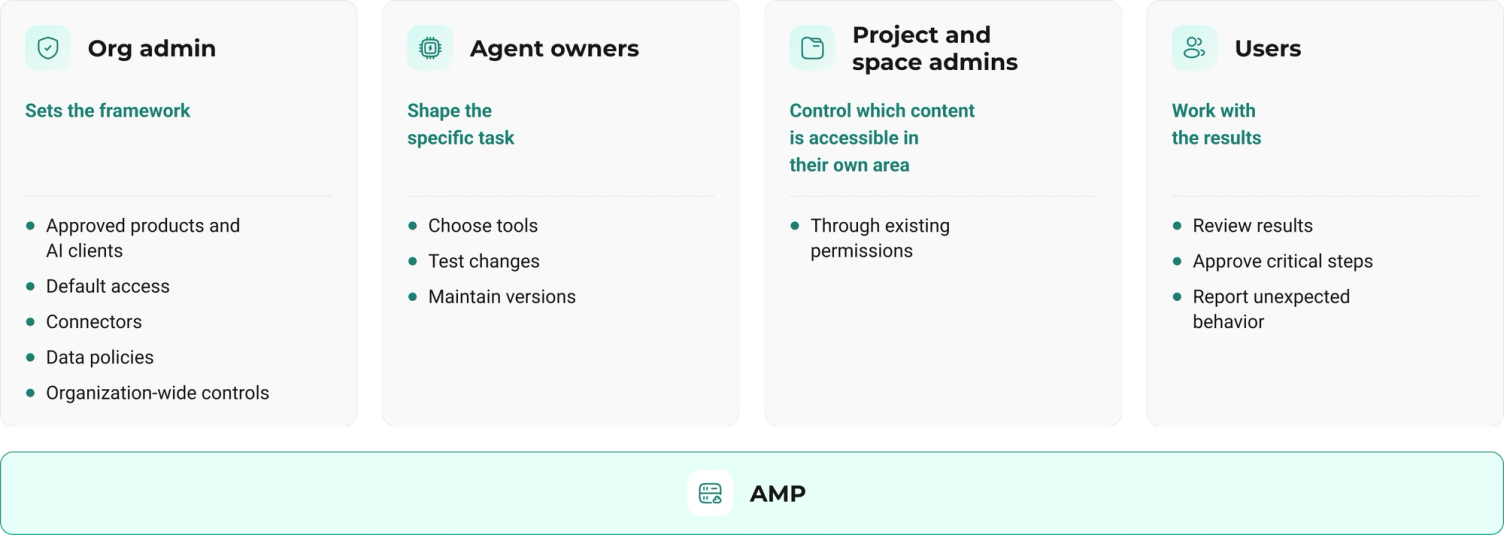
A sound legal and organisational framework requires clear organisation-wide admin guardrails, correct configuration by agent owners and conscious responsibility from users. A scalable agent landscape needs clear ownership. Organisation admins set the boundaries: authorised products and AI clients, default access, connectors, data policies and overarching controls. Agent owners define the task, select tools, test changes and manage versions. Project and space admins use existing permissions to control which content is accessible. Users review results, approve critical steps and report unexpected behaviour.
This division avoids two common problems. Central IT should not have to make every business decision alone. Equally, business teams should not operate agents with extensive permissions whose access and effects are invisible to security and compliance.
A simple responsibility matrix for each agent helps:
- Who owns the business use case?
- Who approves data sources and permissions?
- Who reviews changes to the prompt, tools or model?
- Who monitors quality, costs and audit events?
- Who can stop the agent if something goes wrong?
If these five questions remain unanswered, the agent is not yet ready for wider use.
Conclusion for Enterprise Teams
In summary:
- Scaling is an operational task: Models provide capabilities; processes, roles and controls make them usable across an organisation.
- Context needs structure and permissions: Connected data adds value when quality and access are properly managed.
- Agents need identity and boundaries: Clear attribution, limited rights and auditability build trust.
- Platform models can accelerate implementation: AMP shows how collaboration, context and governance can be brought together technically.
Organisations are best placed when they clean up their data, permissions and processes before a broad rollout. One small, measurable pilot offers more direction than a multitude of disconnected experiments.
Before enabling more agents, take a shared look at a specific process. In an Agentic AI Governance Workshop, we identify a suitable pilot use case with you, map data and permissions, and define the main controls and success criteria.