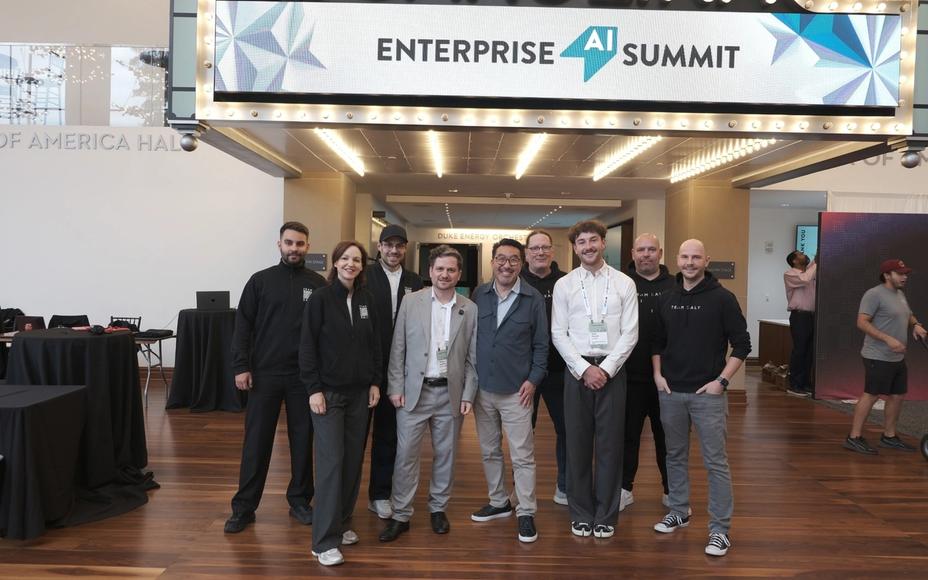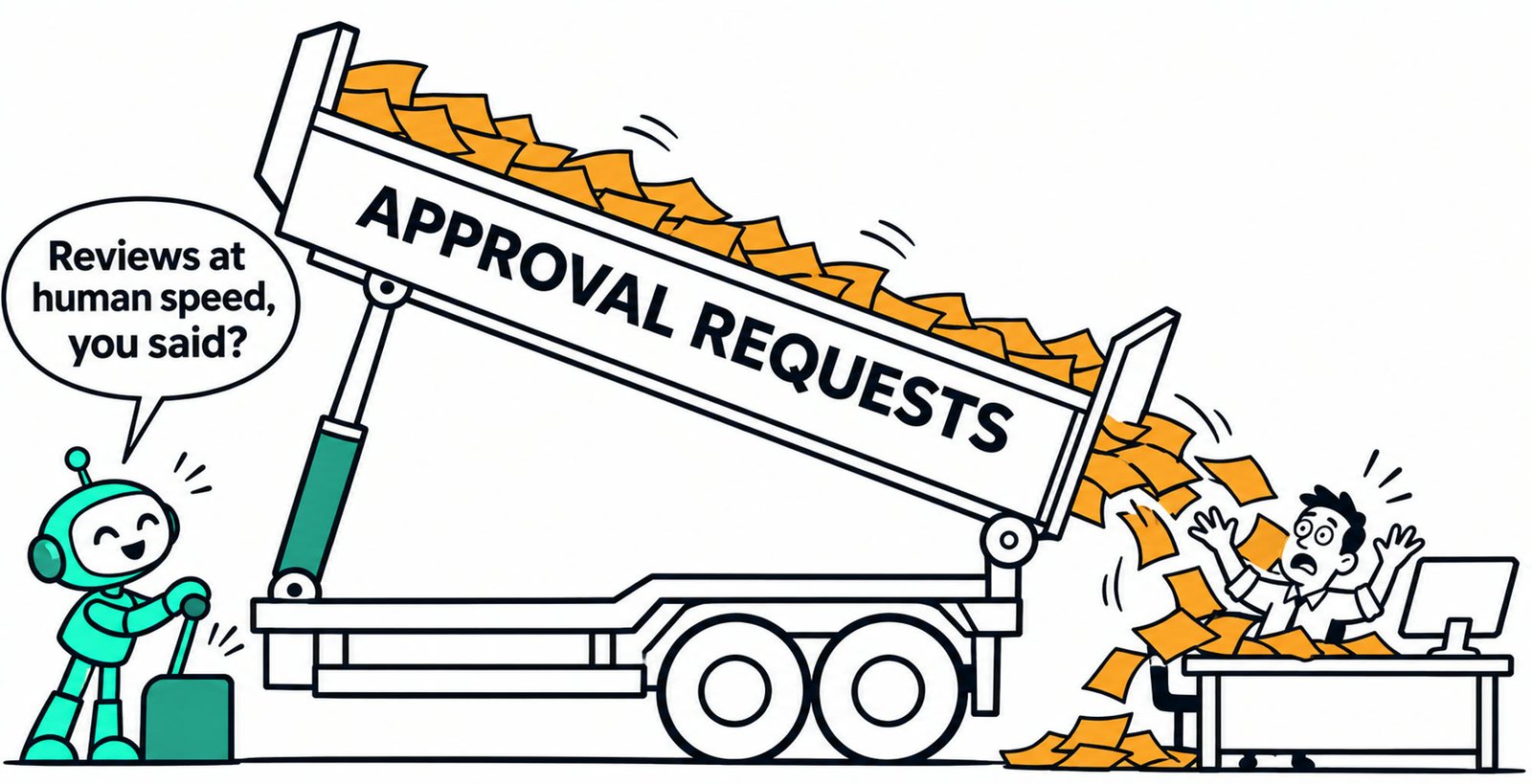
“Requests at AI speed. Reviews at human speed. What could go wrong?” That is how Jonathan Smart sums up, in a LinkedIn post of 20 November, the problem every engineering team is hitting right now. Gene Kim, who introduced our talk at the Enterprise AI Summit in Charlotte, liked the post. Our answer is something we use ourselves: risk-based auto-approvals.
Agents deliver requests faster than people can review them
A coding agent produces a pull request in minutes. A human often needs longer to review it than the agent needed to write it. With one agent that is annoying, with twenty agents it becomes a queue. The human in the loop turns into the person who is supposed to wave everything through, and anyone who only clicks under pressure has stopped reviewing. How we train the habit of looking closely is described in Keep your judgement sharp.
Two ways out suggest themselves and both cost quality: wave everything through, or review everything by hand and become the bottleneck yourself. In the first case you lose control, in the second the speed you introduced the agents for.
Risk-based auto-approvals: a video for small changes, the code for big ones
The idea comes from Kilian Warmdt on our team. Every change gets a risk tier. For low risk, the reviewer watches a short video that shows the change in the real application and clicks approve. Nobody reads the diff. In the video the reviewer sees what the user will see in the end and can hold it against the ticket.
- Low risk: a video and one click on approve.
- Higher risk: a human reads the code as well.
- When in doubt: rate it one tier higher.
How we built for the Enterprise AI Summit
For the Enterprise AI Summit in Charlotte, a team of six built the chief of staff that accompanies every attendee. The foundation comes from the DevOps Handbook: 6,000 test cases, one Jira ticket per change, reviewed pull requests and infrastructure as code. The Jira tickets went to an orchestrator agent that wrote the code. With around twenty features a day, soon nobody knew exactly what was being built. How the whole team works in one shared agent session is described in OpenClaw Multiplayer in the enterprise.
This is where the video came in. Every change got a before-and-after video, and low-risk changes went through video and approve button. Everything else still went through the code. A feedback button in the app became a ticket and reached production in under an hour. Philipp Göllner talks about 80x speed in the talk: four weeks became two hours.
What a review video has to deliver
A video only counts as evidence when it is more than a screen recording. Visual Review attaches the video, the untouched recording and one line per acceptance criterion to the ticket. Every video also states what it does not prove. The films run 25 to 45 seconds today. A person keeps the approval, and the tool never changes the ticket status on its own.
Where the automation stops
One question is still open, and we asked it in Charlotte too: how do you handle high-risk tickets? A single change took down 50 deployed servers for us, and Ben Miller on our team spent five days, 14 hours each, repairing it. From a video you can read what a user sees. What happens in the infrastructure stays hidden in it. Changes like that still need people who know the code and several quality gates in front of them. How many layers of automated checks are enough before a human, we have not decided yet.
Review by risk turns the bottleneck into a decision
What we take away:
- Risk tier before the review: every change gets a tier, the higher one when in doubt.
- Video instead of diff for low risk: a person takes a short look and approves.
- Before and after as the default: every change shows what changes for the user.
- High risk stays manual: the code is read, with quality gates in front.
- The human keeps the decision: the automation selects what the human sees.
Your next step: watch the talk
Philipp Göllner explains the whole flow in his talk Building The Chief of Staff Agent 80x Faster in the IT Revolution Video Library: he explains the before-and-after videos and the risk-based approval in the second half. More stops on our journey are on the AI World Tour.