Good and efficient customer service is a decisive competitive advantage, especially as providers have become easily interchangeable in the digital age. To deliver outstanding customer support, companies need a solution that efficiently manages customer inquiries, relieves support staff, and improves the customer experience. Jira Service Management (JSM) has established itself as a versatile and powerful platform that covers customer support in addition to traditional IT service management. In this article, you will learn why Jira Service Management as a Customer Portal is the ideal and future-proof solution.
Increasing efficiency despite rising customer inquiries: Why flexible solutions are in demand
Companies face the challenge of efficiently handling rising customer inquiries, while conventional tools are often expensive, inflexible, and difficult to use. According to Gartner, many companies suffer from complex systems that cannot keep up with the speed of modern customer needs. In the same vein, organisations lose up to 25% of their efficiency due to fragmented IT systems and silos, as Forrester has found. This creates an urgent need for a solution that is easy to implement, promotes collaboration, and saves costs in the long term.
Available Customer Support Portal systems on the market
There are numerous solutions on the market:
- Zendesk
- ServiceNow
- Jira Service Management (JSM)
- Salesforce Service Cloud
- Freshdesk
While many of these tools have specific strengths, no platform is as comprehensively integrated as Jira Service Management. According to a report by Forrester, the combination of ease of use, powerful features, and modern technology has convinced many companies.
Info box: We recently published a detailed feature comparison of the top 3 solutions, Zendesk, ServiceNow, and JSM: Service Management Platforms Compared: Jira Service Management vs. ServiceNow vs. Zendesk - XALT
The top 5 challenges with current customer support systems
1. Fragmented teams and insufficient integration
Many platforms struggle to effectively connect developer, IT, and business teams. This leads to silos and delays problem resolution.
JSM offers a central platform that integrates seamlessly with DevOps tools such as Bitbucket and Confluence. Teams can collaborate more effectively and resolve incidents faster.
2. Limited flexibility for non-IT teams
Tools such as Salesforce Service Cloud or ServiceNow focus heavily on IT service management and offer little flexibility for other business areas such as HR or facility management.
In JSM, teams can independently set up and manage support portals, which promotes autonomy and relieves IT teams. Currently, 60% of users use JSM for non-IT support.
3. Overloaded features and unnecessary complexity
Many platforms, particularly ServiceNow, offer extensive features that are not always needed. This leads to a cluttered user interface and increases the learning curve.
JSM offers an intuitive, user-friendly interface with a modern ITIL implementation. Teams can enable only the features they actually need, which enhances usability.
Find out here: 5 reasons why classic support systems fail – and how to solve the problem once and for all.
4. Complexity in implementation and maintenance
Many systems such as ServiceNow or Salesforce Service Cloud require expensive consulting services and lengthy implementation phases. In addition, maintenance is often complex and requires significant IT resources.
JSM is easy to implement with pre-built templates and AI-assisted configuration. Automatic updates ensure continuous innovation without downtime.
5. Hidden costs and unclear pricing
Tools like ServiceNow are known for their opaque licensing models with hidden additional costs for modules and add-ons. Freshdesk and Zendesk also often charge fees for additional users or features.
JSM, on the other hand, operates with transparent pricing without hidden fees.
Top 5 reasons why Jira Service Management as a Customer Portal is the ideal and future-proof solution
The main reasons why JSM is the ideal solution for excellent customer support today and in the future are based on a combination of user-friendliness, integration, and modern technology.
1. Seamless integration and collaboration
Efficient processes above all require seamless collaboration between all parties involved and thus the elimination of silos within companies. JSM enables close collaboration between development, IT operations, and business teams by allowing incidents, changes, and support requests to be handled on a single platform.
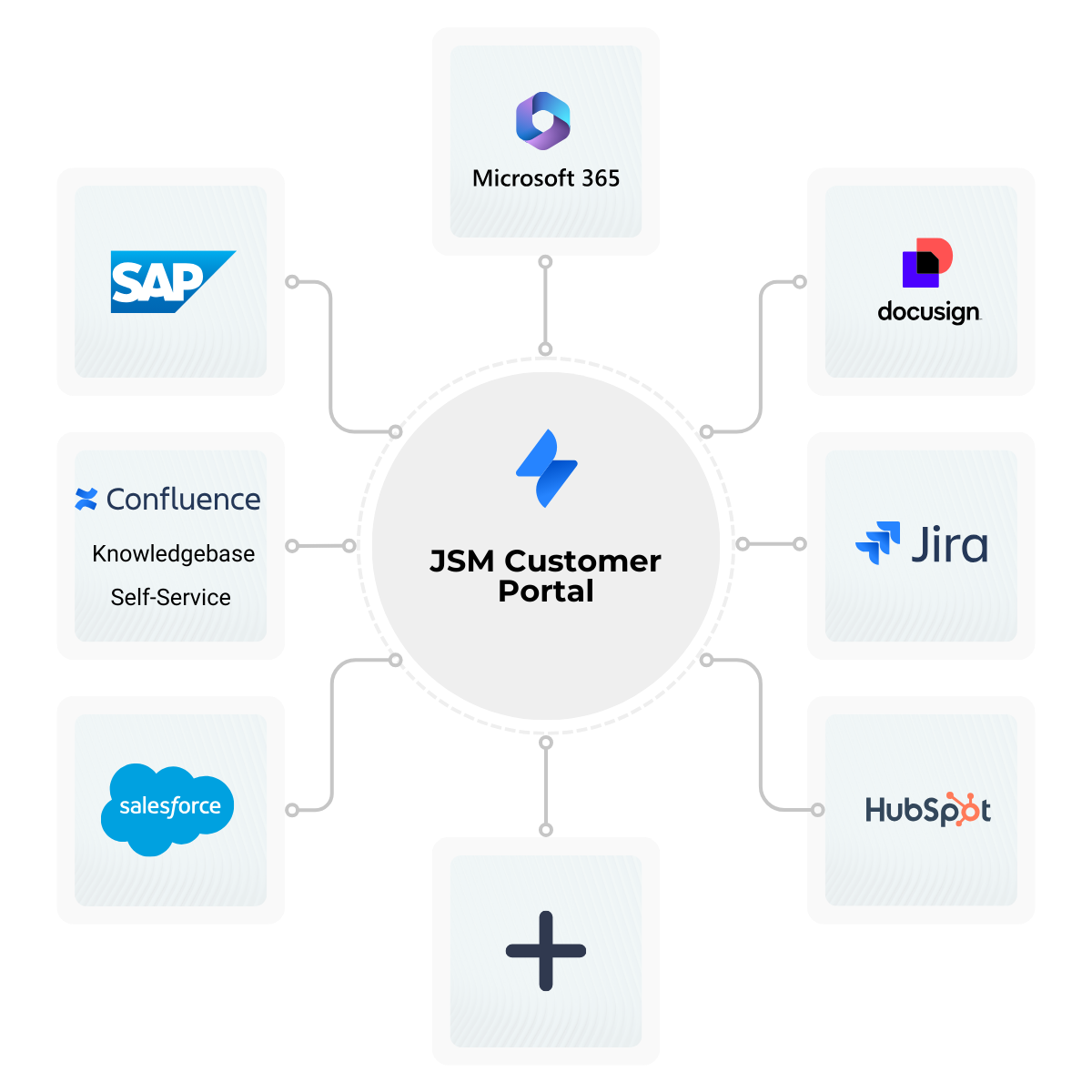
Through integration with other Atlassian tools (e.g., Jira for ticket management or Confluence as a knowledge base for self-service), as well as the ability to integrate third-party systems (e.g., Salesforce, Hubspot, M365), JSM provides a central view of work processes.
As a result, customer satisfaction increases, as they can handle their requests independently via self-service. At the same time, the optimized communication and transparency through the central support system lead to customer problems and requests being resolved more quickly.
2. Modern AI-powered features
AI can significantly relieve support teams by independently handling recurring, administrative tasks, answering routine inquiries, and giving support staff the freedom to focus on more complex themes. Jira Service Management uses generative AI to automatically process requests, analyze incidents more quickly, and provide summaries for support staff. These features are already included in the Premium and Enterprise offerings, at no additional cost. Examples include virtual agents, AIOps features, and AI-assisted configuration.
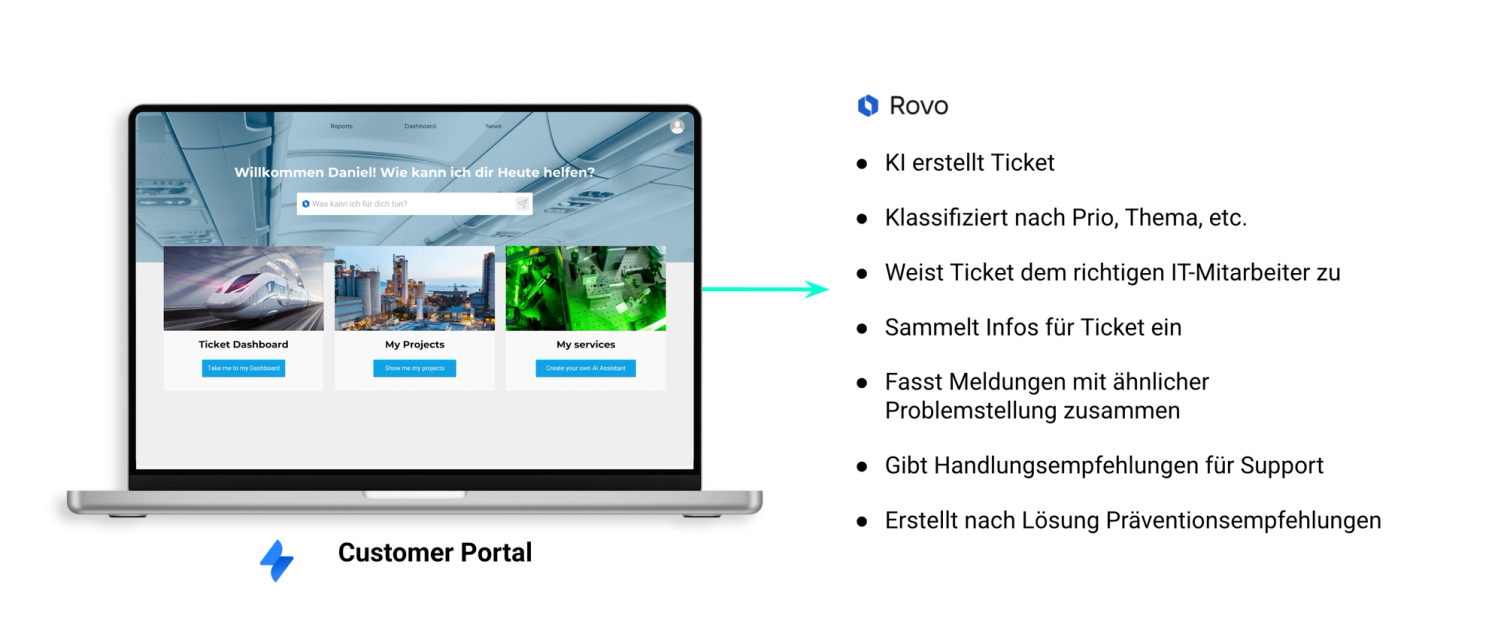
An AI-powered customer support portal relieves your teams and helps solve problems faster.
Info: AIOps (Artificial Intelligence for IT Operations) refers to the use of artificial intelligence and machine learning to make IT operations processes more efficient and intelligent. AIOps features help analyse large volumes of data from IT systems, detect issues, prioritise them, and suggest or implement automated solutions.

6 AI Customer Support Trends for 2025
Reduce costs, increase customer satisfaction and impress with AI-supported support.
3. Flexibility for IT and non-IT teams
Jira Service Management is not designed solely for IT teams. Non-technical teams such as HR, accounting teams, or customer support can independently set up and manage their service portals thanks to JSM's user-friendly interface and configurable workflows. This autonomy enables businesses to centralise customer interactions while reducing reliance on IT resources.
4. Faster implementation and ease of use
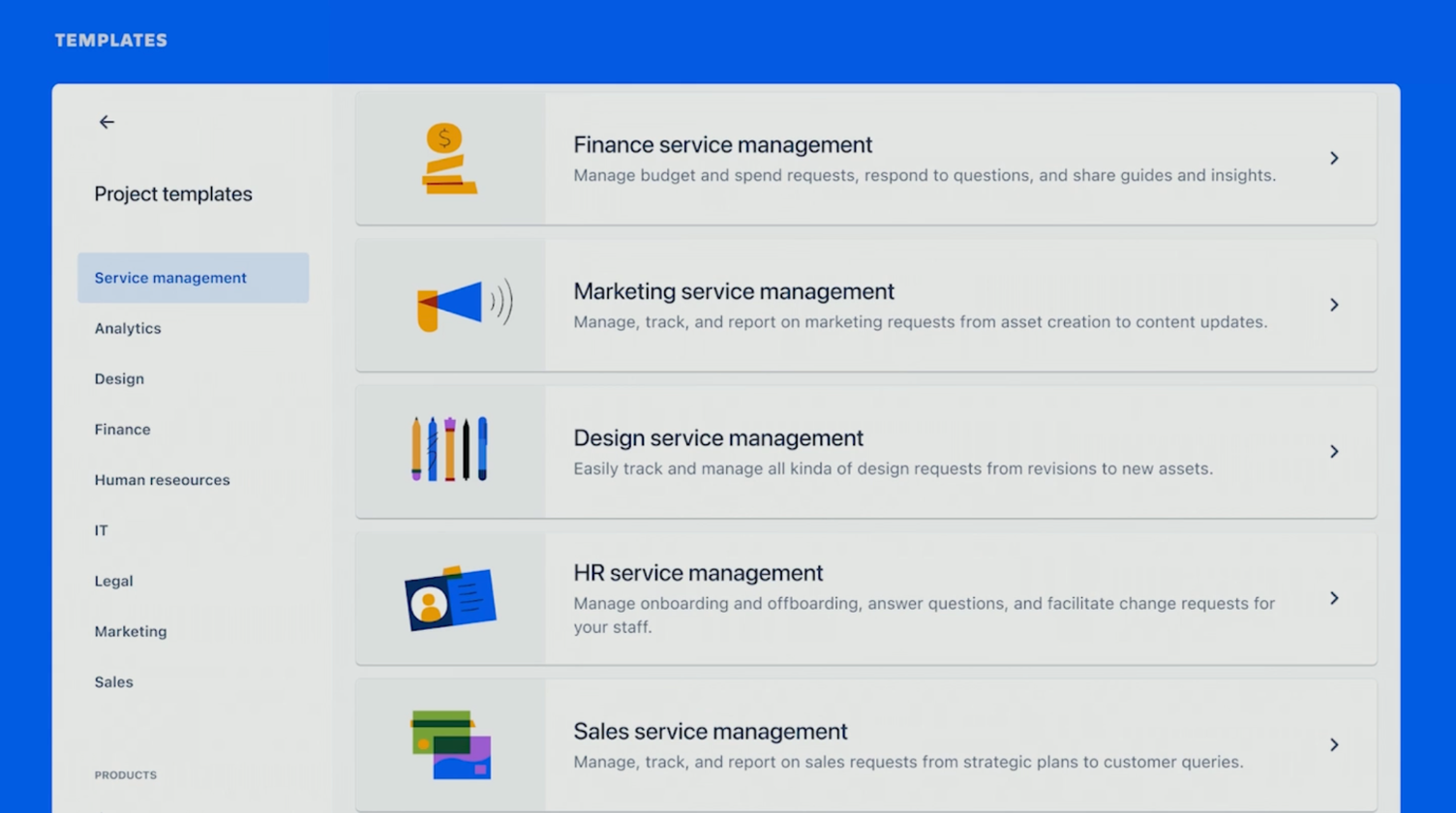
Compared to complex alternatives such as ServiceNow, Jira Service Management is easy to set up and use. Thanks to pre-built templates, out-of-the-box workflows, AI-driven configuration, and a user-friendly interface, teams can quickly adopt the platform. Teams can configure and customise the platform to meet their specific support requirements while remaining aligned with other processes across the enterprise. This significantly shortens the 'time-to-value' without the need for expensive consulting services.
On Forrester, you can calculate the ROI of Jira Service Management specifically. Follow this link to do so: Calculate ROI.
5. Transparent pricing model and cost control
Jira Service Management offers clear, inclusive pricing. The platform charges on a per-agent basis, with no additional fees for end users (e.g., customers submitting requests). There are no hidden extra costs, as is common with other providers, such as through add-ons or separate modules. Unlike many competitors, JSM provides robust support features without requiring additional modules or unexpected expenses during renewal periods.
This ensures affordable scalability, even as your customer base grows, and cost transparency ensures that budgets are not exceeded.

Info box: The ROI of Jira Service Management - Work Life by Atlassian
Conclusion
Jira Service Management combines flexibility, innovation, and cost efficiency into a customer support portal that excellently meets the needs of modern businesses. Its transparent pricing, intuitive setup, collaborative platform, and AI features make it an outstanding choice for businesses looking to improve their customer service and prepare for current and future customer demands.
By leveraging the robust functionalities of JSM, your business can deliver exceptional support quality, strengthen customer trust, and increase team efficiency.