Are you tired of cluttered tools and fragmented projects? Teams that often work on a project basis juggle numerous tasks daily: they coordinate distributed colleagues, manage deadlines, and fight against information silos.
A recent study by the Enterprise Strategy Group (ESG) shows how much an integrated work management platform can reduce these hurdles. Below, we first outline the most common stumbling blocks in day-to-day project work and then present solutions.
Everyday challenges in project management
Constant interruptions and context switching
Every ad hoc request, every tool switch pulls the team out of the workflow. According to ESG, each employee experiences an average of 21 irrelevant interruptions per week, which costs valuable time and focus.
Information silos and high search effort
Project knowledge is often scattered across emails, chat histories, and folder structures. This is challenging for individual employees but a nightmare for newcomers. ESG analyses show that employees spend up to 40% of their time gathering the information they need.
Tool proliferation
Many organisations use six or more collaboration tools in parallel. This not only makes work more difficult because you have to switch between different tools to perform certain work steps. It is also associated with rising licence and security costs. Up to 40% of the IT budget is spent on after-the-fact corrections to fragmented systems.
Lack of reusability
How was that again in a similar project last year? This question, or something similar, regularly comes up in kick-off meetings. Without central templates and a lessons-learned database, every project starts from scratch. This leads to recurring errors and extends project durations by an average of 25 %.
Long onboarding phases
New team members often need four months to become fully productive. They have to learn which tool is used for which purpose and where information is stored across various locations. A unified platform can halve this phase to around 2.4 months, thereby quickly freeing up hundreds of hours of additional productivity.
The solution: An integrated work management platform for project coordination and teamwork
A single, connected environment seamlessly links tasks, documents, and status updates from the first idea to the final report. It is the foundation for implementing the following success factors for efficient teamwork.
Standardised workflows and automations
Project templates bundle best practices into reusable workflows. Instead of structuring every task from scratch, the team relies on proven steps, from requirement capture to acceptance. Automations (e.g. via Atlassian Rovo) take over routine tasks such as:
- Status change notifications only for actual progress
- Due date reminders only to those involved
- Automatic creation of sub-tasks
Benefits & Impact:
- Interruptions drop by up to 35 % because annoying follow-up questions are eliminated.
- Teams start projects 25 % faster, as the planning phase is clearly defined and immediately available.
Central knowledge and document management
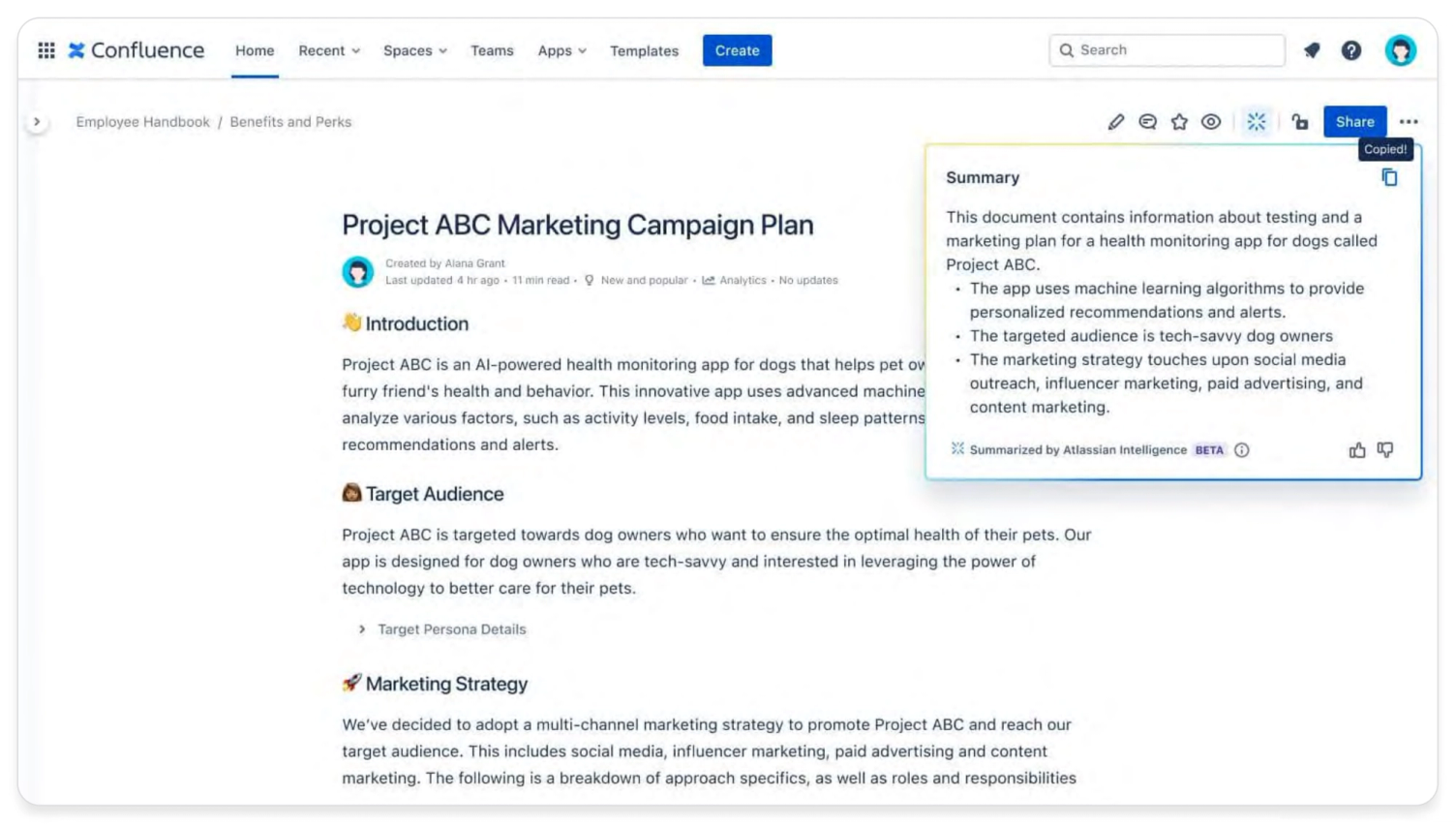
All relevant documents, from specifications to meeting minutes, are stored in a single, searchable hub (e.g. Confluence by Atlassian). Full-text search and AI-powered summaries make it possible to access important details within seconds. Historical projects are always accessible via “Lessons Learned” pages.
Benefits & Impact:
- Research times are halved, freeing up hundreds of thousands of hours of productivity annually.
- New colleagues find all important information 40% faster during the onboarding phase and become productive after 2.4 instead of 4 months.
Real-time transparency for all stakeholders
Live dashboards and automated status feeds provide project managers with a clear overview of progress, risks, and capacity utilization at any time. They display current status data on:
- Where is each task?
- Which risks are accumulating?
- What is the utilization of individual teams?
Automatically generated status feeds inform stakeholders only when there is a genuine need for action.
Benefits & Impact:
- Decisions can be made up to one hour per team member and week faster.
- Coordination meetings become less necessary, as all parties are always on the same information level.
Continuous improvement and governance
Project blueprints and checklists are maintained centrally. Approved versions are available to all teams, including
- Pre-configured risk management check
- Standardized review loops
- Automatically documented change tracking
Benefits & Impact:
- Errors in the process are reduced by around 18%.
- PMO leads gain control over governance processes and can more easily meet compliance requirements.
- The 'blank page' problem, where every project starts from scratch, is resolved.
Scalable onboarding & team alignment
New team members go through an integrated onboarding process with:
- Automatically assigned training tasks
- Linked knowledge tracker for quick guides and SOPs
- Real-time mentoring feeds that notify responsible parties when questions remain unresolved
Benefits & Impact:
- Time-to-productivity drops from 4 to 2.4 months, saving over 30 FTE-months per 100 new hires.
- Unified process understanding strengthens cross-functional collaboration.
Use case: Faster market launch of software features thanks to the Atlassian Teamwork Collection
The Atlassian Teamwork Collection offers an app bundle for project teams that meets the requirements of a modern work management platform.
Now consider the following scenario: Your team is planning the launch of a new software feature. Without an integrated environment, participants jump between emails, chat tools, and various project apps, status updates arrive in different channels, and coordination meetings drag on. Now, let's strategically deploy the apps of the Atlassian Teamwork Collection, Confluence, Jira, Rovo, and Loom:
1. Idea and framework planning in Confluence & Rovo
The team starts in Confluence with a central page where stakeholders compile requirements, user stories, and competitive analyses. Thanks to structured page templates, all relevant points such as goals, risks, and timelines are visible at a glance.
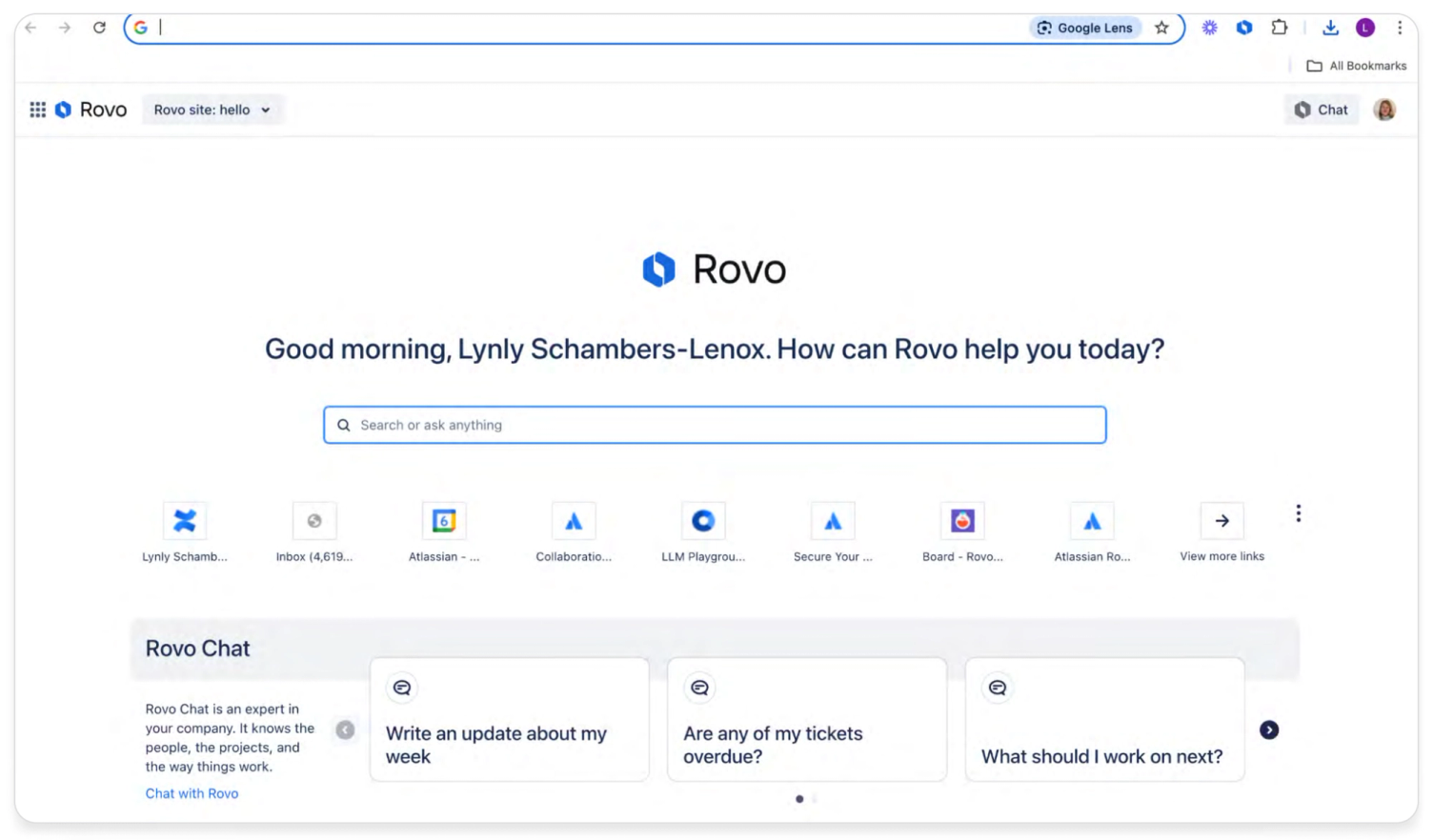
In parallel, users leverage Rovo's chat assistant to ask about comparable projects or to have existing Confluence pages summarised quickly. For example, if someone wants to know how previous marketing releases went, they type a query into Rovo and immediately receive relevant links and insights – without any manual searching.
Challenge solved: Information silos and lengthy search efforts.
2. Detailed planning and tracking in Jira & Rovo
Confluence stories automatically generate Jira tickets via the 'Create Issue' link. These can be assigned to a defined company goal using the Goals App to transparently show which goal the project supports.
Additionally, the Rovo Agent can initiate automated workflows: creating new tasks, automatically notifying QA as soon as a story moves to the review stage, and generating weekly progress reports. This eliminates repetitive status pings, allowing the team to stay on top of things without leaving the board.
Challenge solved: Interruptions caused by status inquiries and inconsistent processes.
3. Team alignment and progress overview in Rovo & Jira
In Rovo's dashboard view, all Jira data comes together live – burndown charts, open blockers, capacity bottlenecks. Using a chat prompt, these metrics can be embedded in Confluence pages or briefly explained directly via a Loom video. Product managers can thus detect early on if the QA team is building up a backlog and can proactively steer the course.
Challenge solved: Unclear capacity planning and lack of real-time transparency.
4. Asynchronous updates and training with Loom & Rovo
Developers create short Loom clips for deployment instructions or architecture walkthroughs. The Loom video is linked directly in a Jira ticket or the linked Confluence page. Rovo can read the content of the videos, enabling new and existing team members to always find the latest learning resources via Rovo chat and without any manual tagging.
Challenge solved: Long onboarding phases and recurring standard training.
5. Go-live and feedback loop
Shortly before the rollout, the PMO team compiles the lessons learned in Confluence. Rovo Agents automatically export the relevant Jira comments and Loom insights into a compact final report for management. Subsequently, the updated project blueprints are stored centrally and are immediately available for the next release.
Result: Through the tight integration of Confluence (Knowledge Hub), Jira (Task Management), Rovo (Search & Automation) and Loom (Video Communication), time-to-market is reduced by around 25%, interruptions decrease by 35%, and the team gains valuable capacity for follow-up projects.
Conclusion: Integrated work management platforms accelerate project timelines
The ESG study impressively demonstrates: An integrated work management platform, such as Atlassian's, creates clear processes, minimizes interruptions and accelerates project throughput.
For PMO leads, this means less operational effort, more strategic headroom and visible productivity effects.
Do you know where your team's quick wins through consolidation lie?
Our Atlassian experts are happy to help you identify the use cases within the Teamwork Collection that offer the greatest potential. Get in touch with us for a no-obligation consultation.