If your organization uses Atlassian products like Jira or Confluence, you've probably already pushed the standard features to their limits. You've configured workflows, set up automation rules, and perhaps even explored the Marketplace. But at some point, out-of-the-box solutions hit their limits.
This is where Forge comes in: Atlassian's platform for developing custom extensions.
After recently attending Team'25 Europe in Barcelona and discussing this topic with experts at Atlassian, I'd like to clarify when you should actually develop something custom – and which approach makes sense for your situation. At XALT, we help clients make these decisions every day. The key is understanding what Atlassian's standard features can't do.
Burak Erol, Ambassador for AI & System of Work at XALT
The Short Version
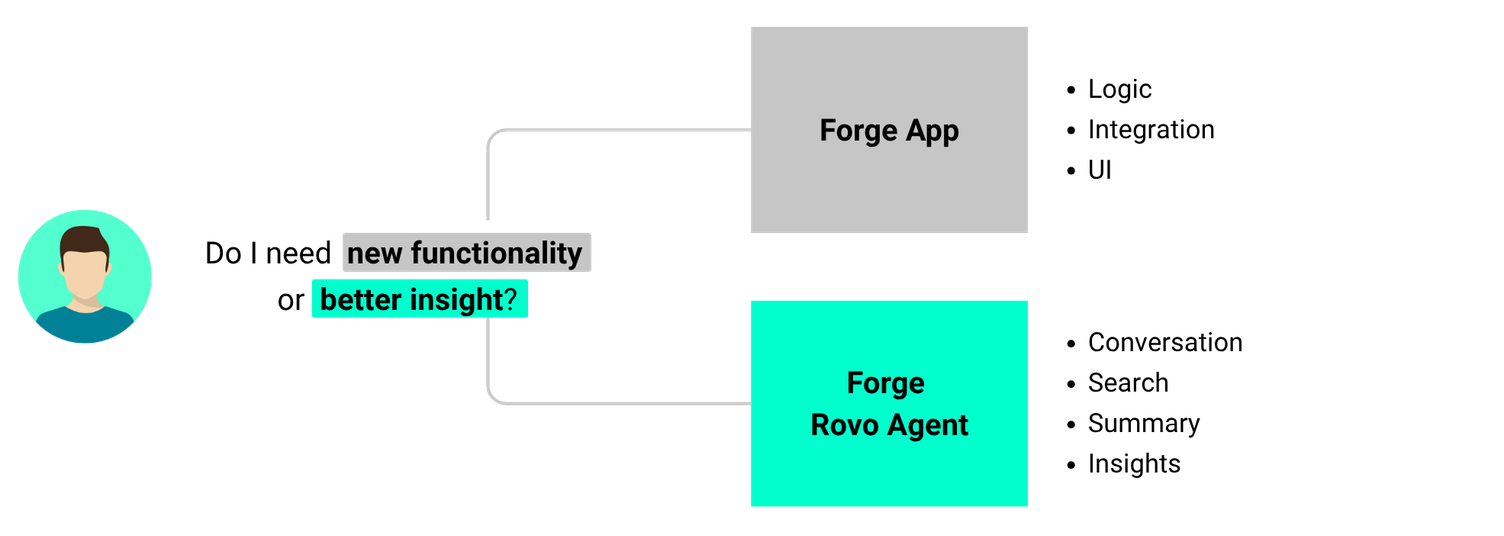
The easiest way to think about it is:
- Forge apps add custom functionality and logic that doesn't exist in Atlassian by default.
- Forge Rovo agents add AI-powered conversation and intelligent assistance.
In other words: apps solve problems that can't be fixed through configuration, while agents enable you to interact with your systems in natural language.
When to build a Forge app
You've outgrown Atlassian's defaults when the following scenarios apply.
1. Your business logic is too complex for built-in automation
Jira's default automation can handle simple if-this-then-that scenarios. But what if you need intelligent routing that analyzes text content, checks external databases, calculates risk scores, or applies rules that change contextually? That requires custom code.
Real-world example:A financial services provider needs an approval routing system that automatically excludes everyone from the approval pool who has previously touched the request. It should randomly select two reviewers from different departments based on current workload and ensure a blind review, where approvers cannot see each other's decisions. This level of intelligent, context-aware logic requires a Forge app.
2. You need data that lives outside of Atlassian
You may need to validate information against your company's master data system, pull real-time pricing from your ERP, check customer rates from your CRM, or enforce policies based on external compliance databases. Forge apps can connect to these systems and bring the data into your Atlassian workflows.
3. Standard fields and forms don't fit your process
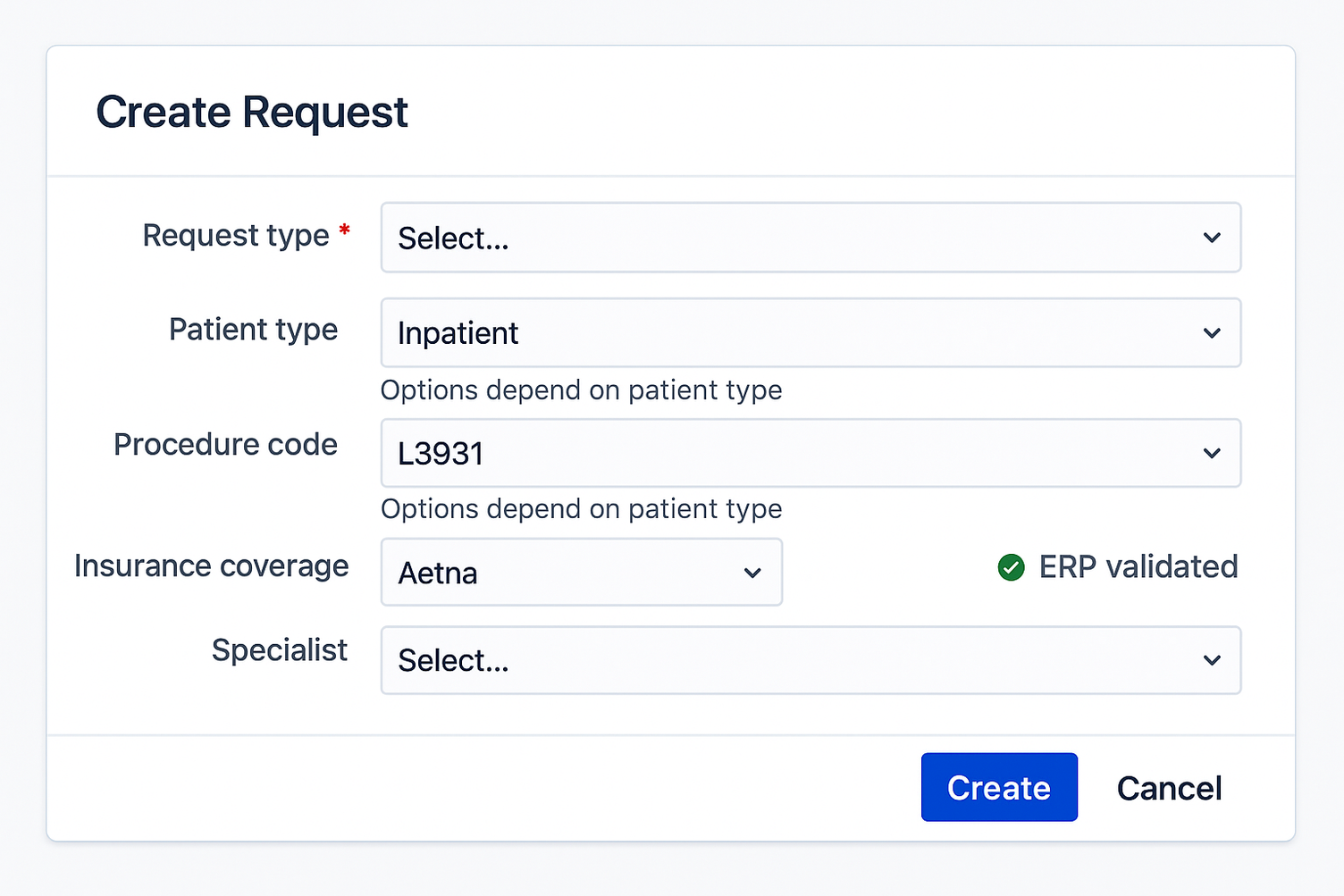
You need forms where fields are shown or hidden based on previous answers, where dropdown options come from external sources, where validation rules check complex business logic, or where submission triggers a multi-step process across different systems.
Real-world example:A healthcare organization needs intake forms whose questions change dynamically based on patient type, regulatory requirements for the specific procedure, current insurance coverage (from an external system), and available specialist capacity – and that validate all of this before the request is even created.
4. You need a custom UI that doesn't exist
Standard Atlassian offers panels, dashboards, and reports. But what if you need a specialized visualization, an interactive diagram that updates based on ticket relationships, a custom sidebar that presents information in a unique way, or an entirely new way to interact with your data?
5. You're building something reusable
When multiple teams or clients need similar functionality that can't be covered through configuration, a Forge app becomes a scalable investment.Build once, deploy everywhere.
Additional examples of requirements that call for a Forge app:
- Custom reports that aggregate data from Jira, Confluence, and three external systems with company-specific KPI calculations
- Bidirectional synchronization between Atlassian and specialized industry systems with complex field mapping and transformation logic
In short: Standard Atlassian can't do it – and neither can marketplace apps.
When to Build a Forge-Rovo Agent
1. Your Team Needs Answers, Not Just Actions
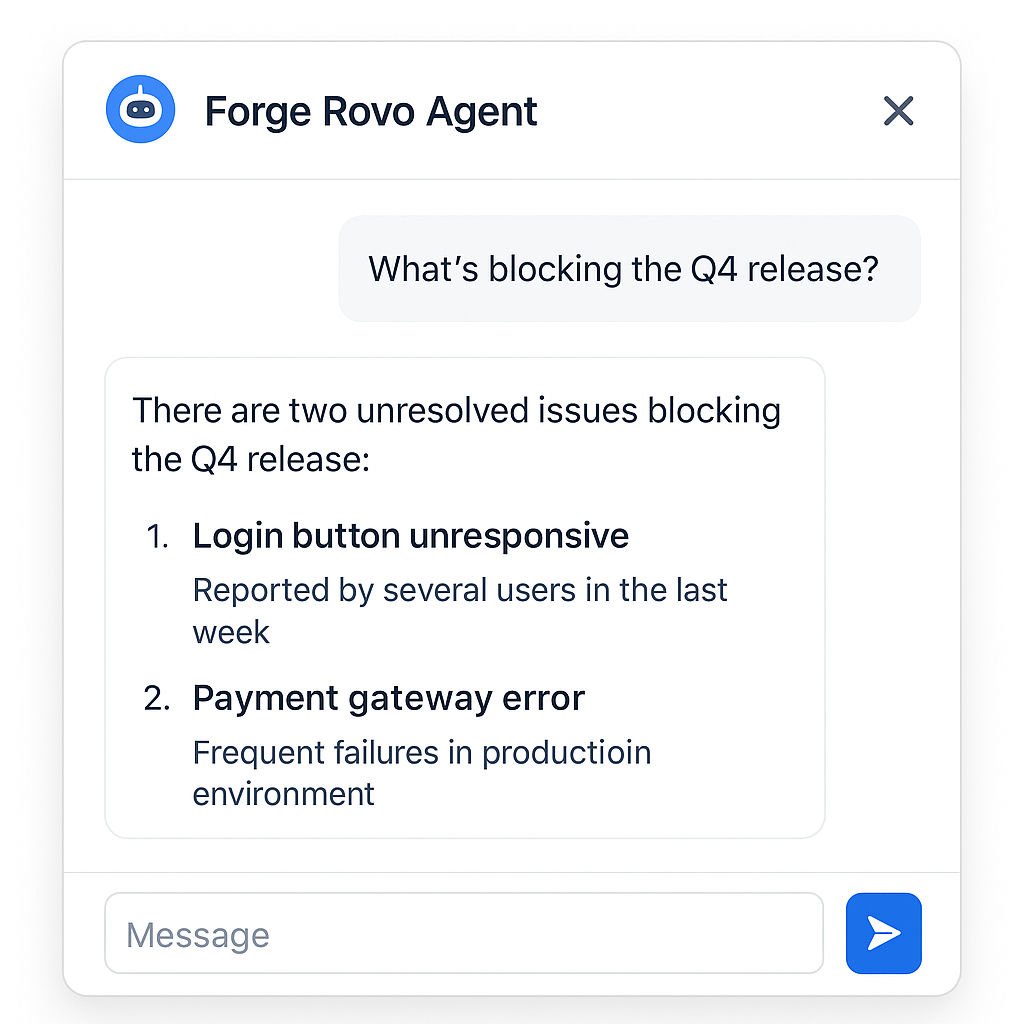
People don't want to learn complex queries, click through dozens of tickets, or piece together information from multiple sources. They simply want to ask: "What's blocking the Q4 release?" or "Show me all critical issues from European customers this month" – and get a clear answer.
2. Information Is Scattered and Hard to Find
When the data exists in Atlassian but finding and understanding it requires expertise, a Rovo agent can bridge that gap. It can search across projects, analyze patterns, summarize results, and present insights – all through a simple conversation.
3. You Want AI to Handle the Analysis
Instead of people reading 50 comments to understand what happened, a Rovo agent can synthesize that information, identify themes, detect trends, and deliver actionable summaries.
4. Non-Technical Users Need Access to Complex Data
Not everyone on your team is fluent in JQL, advanced filters, or knows where to find specific information. A Rovo agent democratizes access – everyone gets what they need, simply by asking a question (in natural language).
Real-world examples:
- What are the recurring themes in customer feedback from the last sprint?
- Summarize the status of all marketing initiatives for next week's leadership meeting.
- Which team members are currently overloaded and need support?
- Show me the history of how we've resolved similar technical issues in the past.
- Generate a draft stakeholder update on the payment system migration.
In short: You need intelligence and conversation, not just functionality.
Which option do you need?
Ask yourself: "Do my tools need to do something they can't do today – or does my team need to better understand what's already there?"
If the Atlassian standard can't execute the logic, integrate systems, or provide the required functionality → Build a Forge app.
If the data exists, but finding, analyzing, and understanding it is the challenge
→ Build a Forge Rovo agent.
Can you do both?
Absolutely. Many sophisticated solutions combine both approaches: a Forge app that implements complex logic and integrations, paired with a Rovo agent that overlays an intuitive, conversational interface on top.
Example:A Forge app handles complex, multi-system approval routing with external validations, while a Rovo agent intelligently and contextually answers questions like "What is the status of my request?" or "Why is this stuck in approval?".
XALT can help you make the decision
Deciding whether you need a Forge app, a Rovo agent, or both is not always straightforward. It requires an understanding of what Atlassian can do out of the box and what your organization actually needs to work effectively.
At XALT, we specialize in identifying the boundary between standard Atlassian and custom development. Our team helps you assess requirements, design the right solution, and seamlessly integrate it into your existing system landscape.
Ready to explore the possibilities? Let's talk about how we can extend your Atlassian environment to fit the way you work.