Unmanageable hardware and software inventories lead to rising costs, compliance issues, and slow IT services. Without structured IT Asset Management (ITAM), your IT operations remain inefficient and expensive.
What is IT Asset Management?
IT Asset Management (ITAM) is much more than just recording hardware and software. It is the strategic process that ensures all IT resources – from physical devices to software licences and cloud services – are managed efficiently, securely, and cost-effectively. Effective ITAM enables companies to maintain an overview of their IT landscape, meet compliance requirements, and make informed decisions about IT investments.
Why IT Asset Management is indispensable
1. Organisational chaos and inefficiency
- Duplicate purchases due to a lack of inventory overview
- Missed licence renewals with the risk of penalties
- Opaque resource allocation that hampers team performance
2. Risks without ITAM
- Cost drivers: Up to 30% of the IT budget is wasted on unused or orphaned assets (Gartner).
- Compliance violations: Inaccurate license management can lead to costly audits and penalties (BSA study).
- Employee frustration: Unreliable systems erode trust in the IT department.
Consequences of poor ITAM practice
- Cost explosion due to uncontrolled license and hardware renewals
- Vendor lock-in: Dependence on providers that dictate unfavorable contract terms
- Growth barriers: Without a clear asset overview, strategic decisions are barely possible
Current challenges in IT Asset Management – and how to overcome them
1. Shadow IT: The invisible danger
Shadow IT refers to the use of IT systems, applications, or services without the approval of the IT department. This often happens out of a desire to work more efficiently or to quickly access needed tools. However, these unofficial solutions can pose significant security risks, as they do not meet enterprise-wide security standards and are not monitored (Gartner Shadow IT).
Solution approach: Implement a central IT Asset Management system that records all tools and services in use. Foster open communication between the IT department and employees. The use of Cloud Access Security Broker (CASB) solutions can help identify and control unauthorized applications (Microsoft CASB Info).
2. Multi-cloud and hybrid infrastructures: Mastering complexity
The simultaneous use of multiple cloud services and the combination of cloud and on-premises solutions significantly increase the complexity of IT management. Different platforms, interfaces, and security standards make the management and monitoring of IT assets more difficult (IDC Multi-Cloud Report).
Solution approach: Rely on integrated ITAM and IT Service Management (ITSM) solutions. Automated discovery tools help manage all assets centrally. A consolidated Configuration Management Database (CMDB) provides an overview of all IT resources (ServiceNow CMDB Guide).
3. Mobile devices and BYOD: Flexibility vs. security
The increasing use of mobile devices and the introduction of Bring Your Own Device (BYOD) programmes increase flexibility but also pose new challenges for ITAM (Statista BYOD figures).
Solution approach: Implement Mobile Device Management (MDM) solutions that enable centralised management and security of all mobile devices (VMware MDM overview).
4. Software licence management: Compliance and cost control
Managing software licences is complex and prone to errors. Over- or under-licensing can lead to costs or legal issues (Flexera Report).
Solution approach: Use Software Asset Management (SAM) tools. Conduct regular audits and negotiate flexible licensing models.
5. Security risks from outdated or unknown assets
Unupdated or unknown IT assets can represent significant security vulnerabilities. Attackers frequently exploit weaknesses in outdated systems (ENISA report on vulnerabilities).
Solution approach: Conduct regular network scans, integrate ITAM with security solutions, and patch all systems regularly.
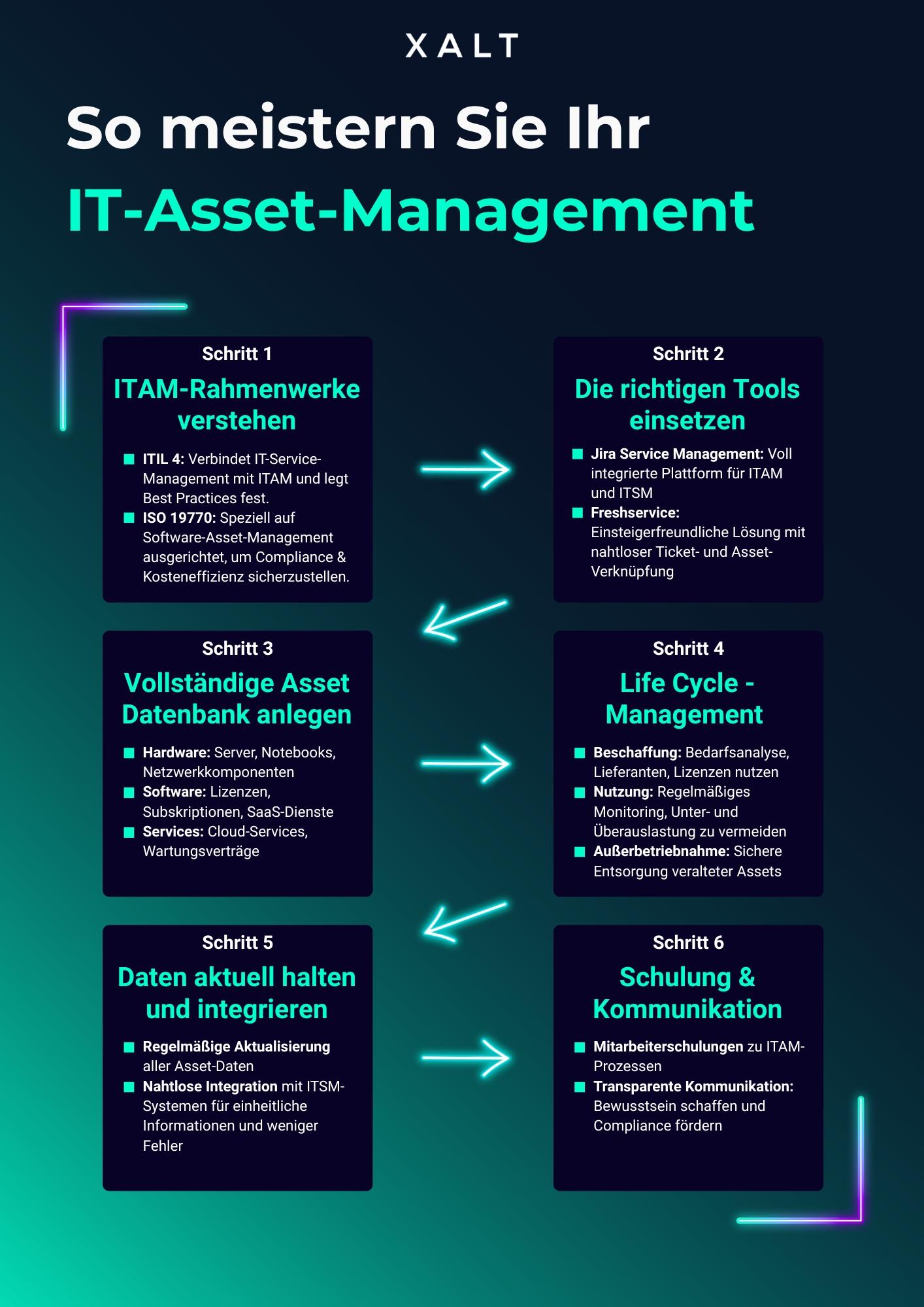
How to master your IT asset management
Step 1: Understanding ITAM frameworks
- ITIL 4: Links IT service management with ITAM and establishes best practices.
- ISO 19770: Specifically focused on software asset management to ensure compliance and cost efficiency.
Step 2: Using the right tools
- Jira Service Management: Fully integrated platform for ITAM and ITSM.
- Freshservice: Beginner-friendly solution with seamless ticket and asset linking. Tip: Test free trials to find the best fit for your company.
Step 3: Create a complete asset database
- Hardware: Servers, laptops, network components
- Software: Licenses, subscriptions, SaaS services
- Services: Cloud services, maintenance contracts
Step 4: Implement lifecycle management
- Procurement: Needs analysis, supplier comparison, use of volume licenses
- Usage: Regular monitoring to avoid under- and over-utilization
- Decommissioning: Secure disposal and recycling of outdated assets
Step 5: Keep data up to date and integrated
- Regular updates of all asset data
- Seamless integration with ITSM systems for consistent information and fewer errors
Step 6: Training and communication
- Employee training on ITAM processes
- Transparent communication: Raising awareness and promoting compliance
ITAM as a strategic strength
In a digitalized world, IT asset management is a strategic necessity. With clear processes, suitable tools, and continuous data maintenance, you can turn ITAM into a growth driver.