For municipalities
Modern market stall allocation for municipalities: structured, transparent, legally sound
Weekly markets, Christmas markets, town festivals: market stall allocation is everyday municipal business. And yet in many administrations it still runs on email, spreadsheets and phone calls.
What's missing is a platform that unites application, review, stall management and AI support in a single process. That's exactly what Jira Service Management is. No third-party apps, C5-compliant.
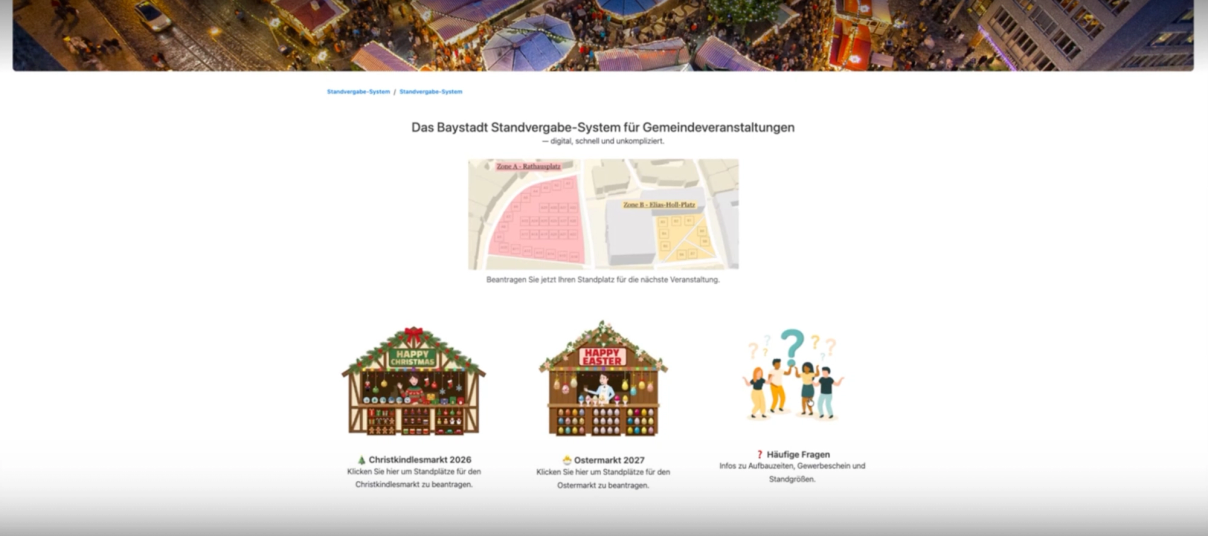
The challenge
What changes
Without Jira Service Management
With Jira Service Management
The solution
With Jira Service Management you build a digital stall allocation system
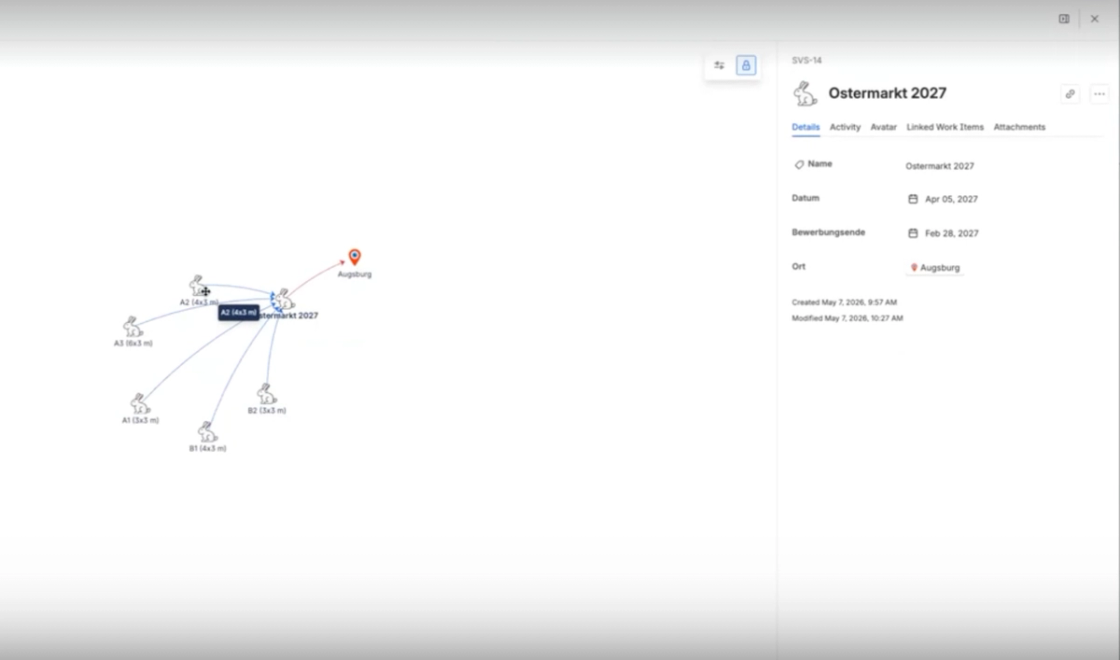
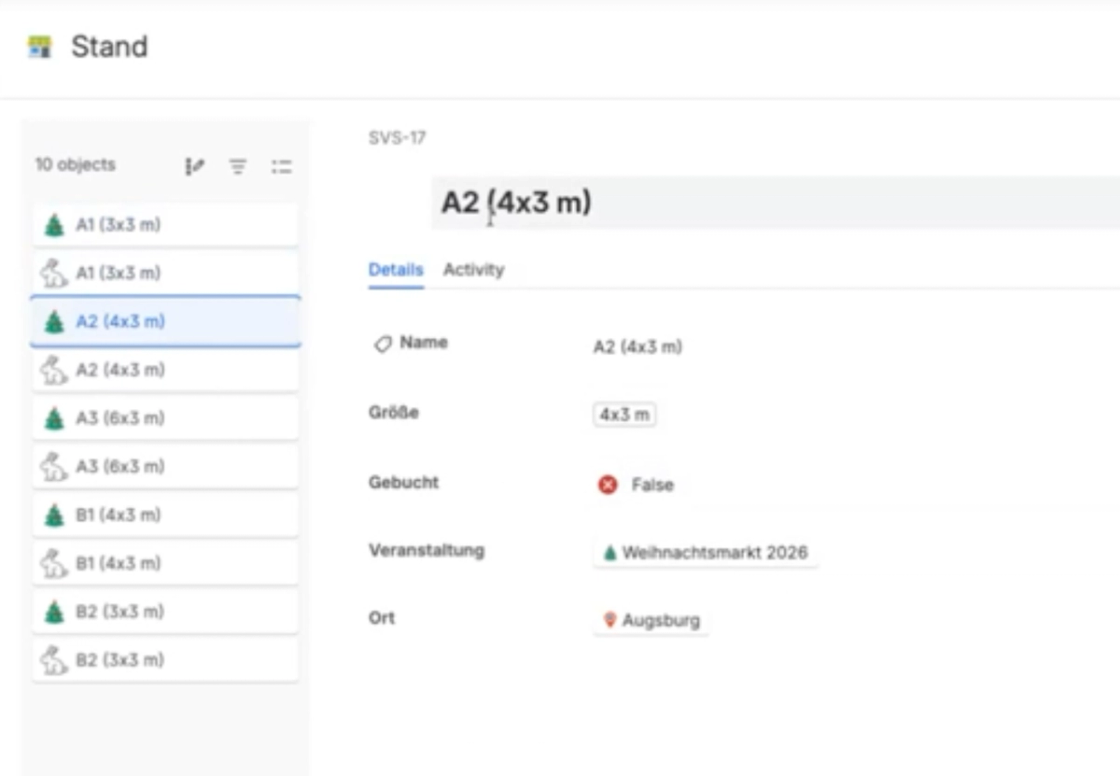
Applicants submit their request through a self-service portal, upload supporting documents directly, and receive automatic status updates. Case workers review and approve requests centrally in structured queues. Stalls and events are managed via Jira Service Management Assets, with real-time availability and a complete occupancy record.
The result: a modern citizen service that supports OZG requirements and saves your team hours every day.
Core features
What the implementation looks like
Self-service portal
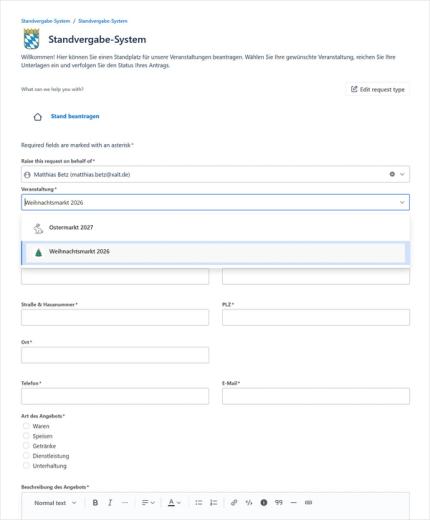
Applicants submit requests online, including document upload.
Structured approval workflow
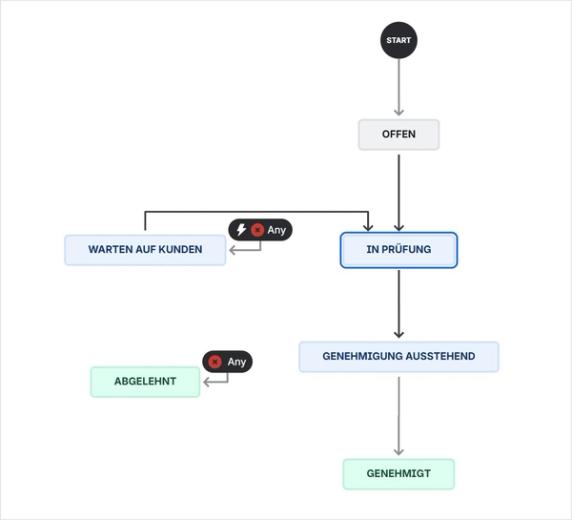
From submission through review and follow-up questions to approval or rejection.
Central processing in queues
SVS Board
| Key | Name | Firma / Organisation | Veranstaltung | Standwunsch Weihnachtsmarkt | Art des Angebots | Status |
|---|---|---|---|---|---|---|
| SVS-19 | Fabienne Gerhard | Super 3D Druck | Weihnachtsmarkt 2026 | A3 (6x3 m) | Waren | Genehmigt |
| SVS-18 | Elene Maier | Pfadfinder Waffeln | Weihnachtsmarkt 2026 | A2 (4x3 m) | Waren | Offen |
| SVS-16 | Matthias Betz | Omas für Nächstenliebe | Weihnachtsmarkt 2026 | A1 (3x3 m) | Waren | Genehmigt |
| SVS-9 | Jonas Meyer | Meyer Event-Technik | Weihnachtsmarkt 2026 | B2 (3x3 m) | Unterhaltung | Genehmigt |
| SVS-8 | Elena Fischer | Fischer Bio-Bäckerei | Weihnachtsmarkt 2026 | B1 (4x3 m) | Speisen | Offen |
| SVS-7 | Maximilian Weber | Webers Kunstschmiede | Weihnachtsmarkt 2026 | A3 (6x3 m) | Waren | In Prüfung |
| SVS-6 | Sophie Schmidt | Schmidt & Partner Konfekt | Weihnachtsmarkt 2026 | A2 (4x3 m) | Speisen | Warten auf Kunden |
| Key | Name | Firma / Organisation | Veranstaltung | Standwunsch Ostermarkt | Art des Angebots | Status |
|---|---|---|---|---|---|---|
| SVS-17 | Helene Mandara | Flora und Mineralien | Ostermarkt 2027 | A1 (3x3 m) | Waren | Genehmigt |
| SVS-14 | Mia Koch | Kochs Grill-Spezialitäten | Ostermarkt 2027 | B2 (3x3 m) | Speisen | In Prüfung |
| SVS-13 | David Hoffmann | Hoffmanns Spielwaren | Ostermarkt 2027 | B1 (4x3 m) | Waren | Warten auf Kunden |
| SVS-12 | Laura Schulz | Schulz Fruchtsäfte | Ostermarkt 2027 | A3 (6x3 m) | Getränke | In Prüfung |
| SVS-11 | Felix Becker | Beckers Kräuter-Eck | Ostermarkt 2027 | A2 (4x3 m) | Getränke | Genehmigt |
| SVS-10 | Amelie Wagner | Wagner Keramik-Design | Ostermarkt 2027 | A1 (3x3 m) | Waren | Offen |
All requests in one place, sorted by priority and status.
Stall management with JSM Assets
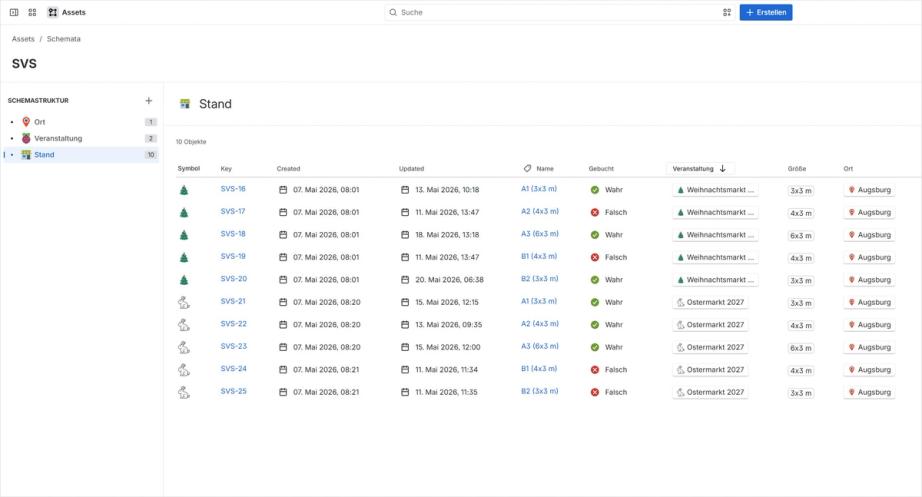
Events and stalls with availability status.
Automated notifications
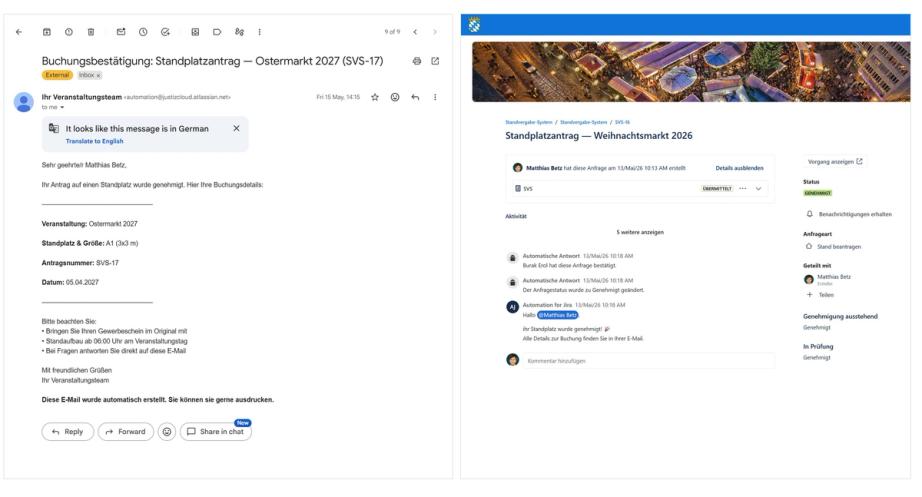
Status updates and confirmations by email and visible in the customer portal, with no manual follow-up.
Management dashboards
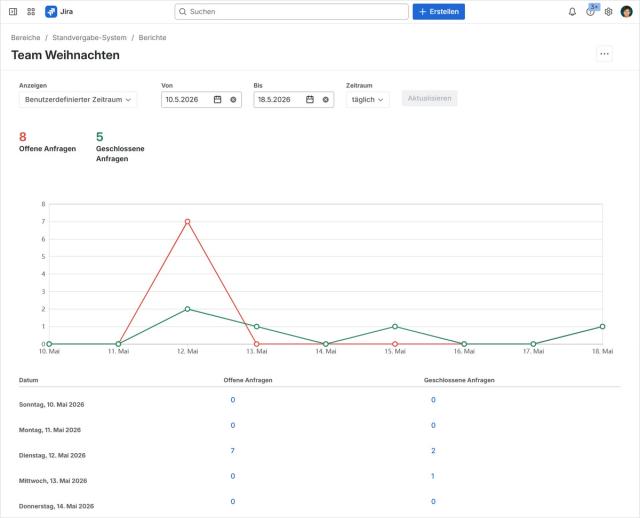
Real-time overview of every application's status.
AI support
AI-supported application processing: Rovo as digital first reviewer
The Rovo AI agent automatically handles the first review step: it checks submitted documents for completeness, categorizes the application by event type and stall, and requests missing documents directly from the applicant—before a case worker even opens the request.
The result: fewer follow-up questions, cleaner queues, faster decisions.
Your benefit
Your benefit
Less administrative effort
Your team works with clear processes; no more endless rounds of coordination. The system checks stall availability automatically; double bookings are ruled out.
More transparency & traceability
All applications and decisions are visible centrally. Every decision is documented and traceable.
Better citizen service
Clear status updates without phone follow-ups.
Fast implementation
Prototype in approx. 15–18 person-days, no additional license costs.
Technology
Technical framework
- Built entirely on Jira Service Management, JSM Assets and native automations
- No third-party apps required
- Deployable on your existing Atlassian Cloud infrastructure
- BSI C5 compliant; suitable for the public sector
- Extensible with AI-supported features (e.g. Rovo AI agent for automatic pre-review)
Next step
Ready for the next step?
We'll show you what a digital stall allocation system could look like for your organization—in a personal demo or a no-obligation first conversation.
Frequently asked questions
Frequently asked questions
No. If your administration already uses Atlassian Cloud, the solution runs directly on your existing infrastructure—no new system, no complex rollout.
With Jira Service Management, municipalities digitize the entire market stall allocation process: from application through review to approval. The system is OZG-compliant and can be implemented without additional apps.
Yes. The solution is specifically designed for recurring municipal event formats (weekly markets, fairs, town festivals). Stalls, application cycles and approval workflows can be configured individually per event type.
Yes. The system is built entirely on Jira Service Management, JSM Assets and native automations—no third-party apps, no additional plugins, no new software license.
A working prototype can be built in about 15–18 person-days. The exact scope depends on the number of event types, approval stages and desired integrations.
Yes. Atlassian Cloud holds the BSI C5:2020 Type 2 Attestation for Jira, JSM and Confluence Cloud—the official security certification for use in German public authorities and institutions. AKDB has been running the platform in production since 2023.
Yes. Through the self-service portal, applicants submit their request digitally, upload supporting documents directly, and receive automatic status updates by email—no need to call the office.
Stalls are managed as assets with real-time availability status. When a request is approved, the stall is automatically marked as occupied—an accidental double booking is ruled out by the system.
The system detects missing documents and requests them automatically. Optionally, a Rovo AI agent handles the completeness check before a case worker even opens the request.
Absolutely. JSM works as a platform for many other use cases – from replacing shared mailboxes to approval processes and internal IT support. AKDB already uses JSM across several areas.
Yes. Workflows, forms, approval stages and asset structures are flexibly configurable and adapted to your specific processes.
If you already use Jira Service Management, there are no additional license costs. The solution is built entirely with what you already have.
It supports OZG-compliant digital application processes, including a self-service portal, structured documentation and a complete audit trail. More: https://onlinezugangsgesetz.de